## Web Cluster Architecture
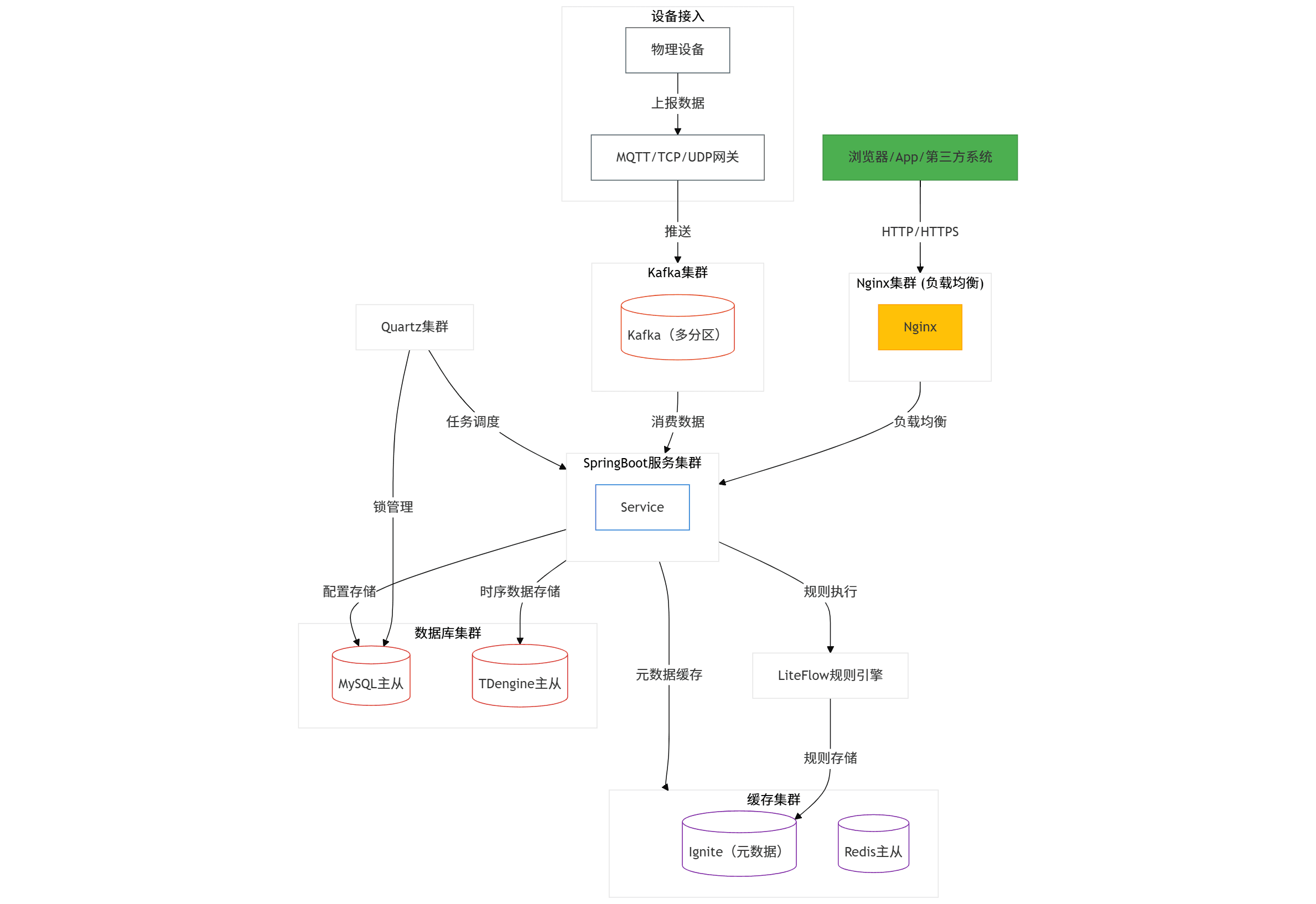
Overall architecture:
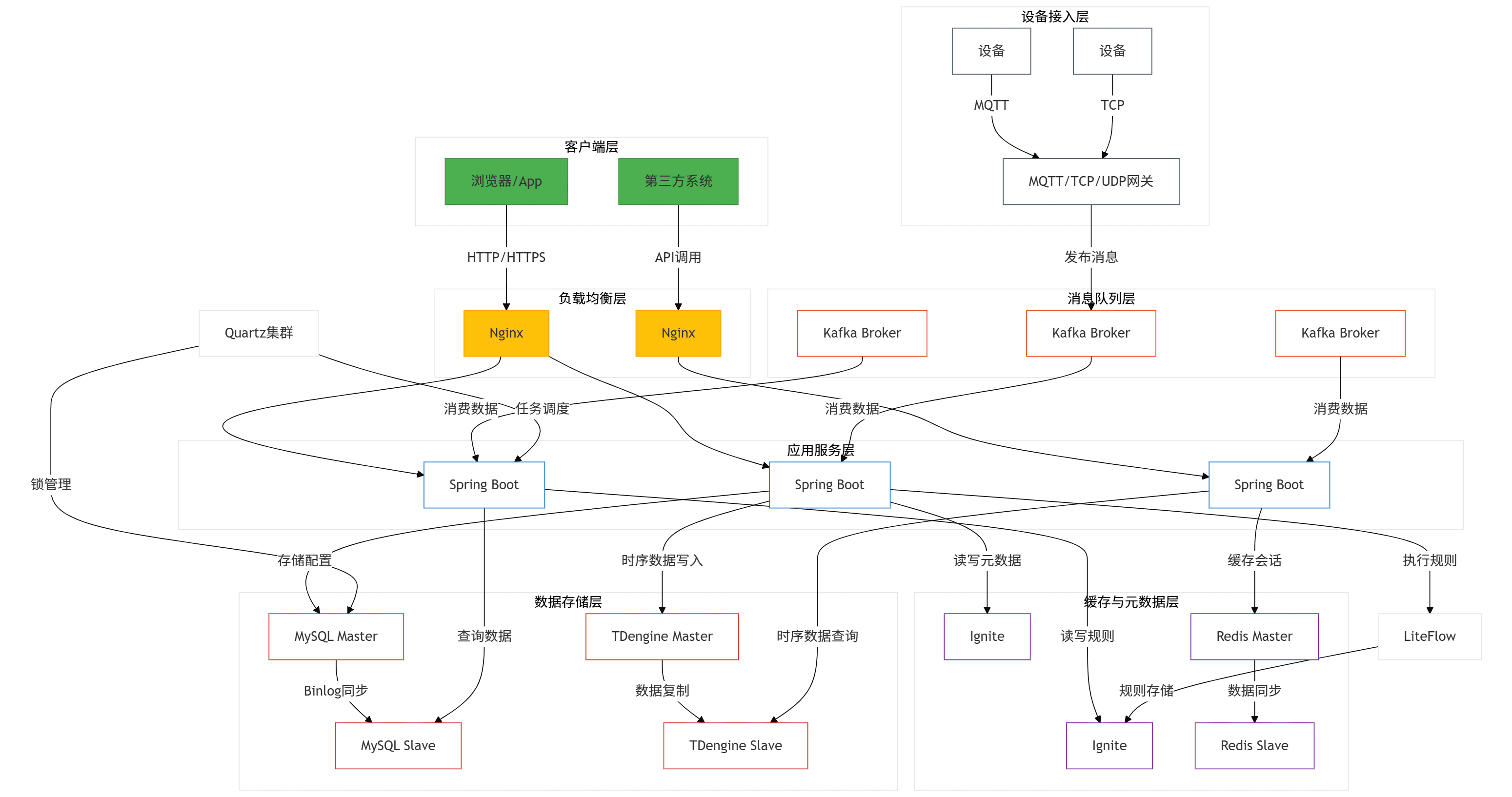
 Detailed architecture:
 ## 1. Client Layer
* Browsers, mobile apps, and third-party systems access the platform through HTTP/HTTPS.
## 2. Load Balancing Layer
* Nginx cluster:
* Reverse proxy and backend load balancing.
* SSL termination and static resource caching.
* Horizontal scaling for high availability.
## 3. Application Service Layer
* Spring Boot service cluster:
* Provides RESTful APIs and handles business logic.
* Multiple instances are deployed horizontally and balanced through Nginx.
## 4. Message Queue Layer
* Kafka cluster:
* Topics can be split into multiple partitions, such as `Partition 1` and `Partition 2`.
* Consumes device data from the FMQ cluster, including MQTT/TCP/UDP service clusters.
* Device gateway services write data into Kafka.
* Spring Boot services consume Kafka data and process device commands, alarms, and other business events.
## 5. Data Processing Layer
* Rule engine:
* LiteFlow executes scene-automation rules such as device linkage and alarm triggers.
* Ignite stores and manages LiteFlow rule configuration and supports dynamic updates.
* Distributed scheduling:
* Quartz cluster runs Modbus polling jobs and coordinates cluster tasks through database locks.
## 6. Cache and Metadata Layer
* Distributed cache:
* Ignite cluster caches device metadata such as device IDs, status, and configuration.
* Integration with Spring Boot provides low-latency metadata access.
* Redis primary-replica architecture:
* The primary node handles writes such as session state and real-time counters.
* Replica nodes handle reads and can be combined with Sentinel for automatic failover.
## 7. Data Storage Layer
* Relational database:
* MySQL primary-replica architecture, where the primary handles transactional writes and replicas handle queries.
* Time-series database:
* TDengine stores historical device data such as temperature and humidity and supports efficient time-series queries.
## 8. Device Access Layer
* Protocol gateway:
* Supports MQTT/TCP/UDP protocol access.
* Forwards device data to the Kafka cluster.
## Key Design Points
1. High availability: critical components such as Nginx, Kafka, MySQL, and Redis use cluster or primary-replica deployment.
2. Data flow: device data -> MQTT/TCP/UDP gateway -> Kafka -> Spring Boot services -> TDengine/MySQL.
3. Performance: Ignite caches device metadata to reduce MySQL pressure, and TDengine optimizes time-series storage and queries.
4. Scalability: Kafka partitions and Nginx load balancing provide horizontal scaling.