


FastBee Pros and Cons: Best-Fit Projects
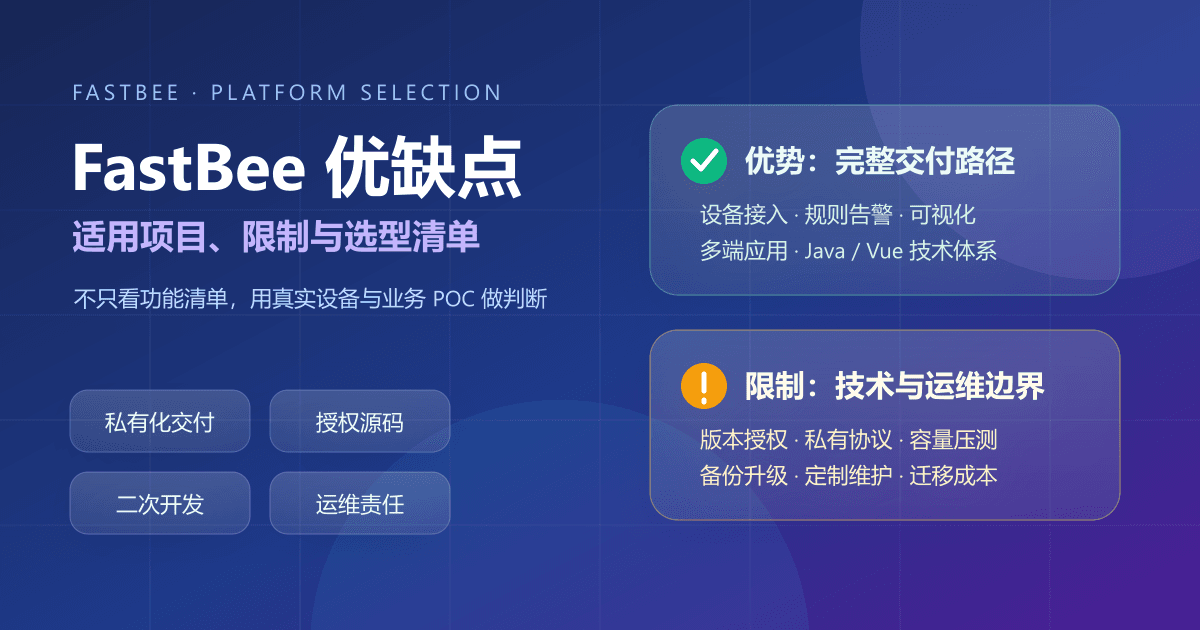
FastBee's main strength is that it brings device connection, Thing Models, rules, alerts, visualization, and multi-device applications into one product path while supporting self-hosting and customization through licensed source code. Its limitations are equally clear: the Open Source Edition should not be treated as a free commercial platform; protocols and features differ by edition; private protocols, custom business workflows, and production operations still require technical work; and device capacity must be tested against real workloads rather than inferred from promotional figures.
FastBee is therefore best suited to teams that need self-hosted delivery, want control over source code, and have—or can organize—Java/Vue and implementation capabilities. Organizations with no technical resources, teams seeking a fully managed service, or projects whose requirements differ substantially from the available protocols and business model should assess implementation costs and compare alternatives first.
1. The short answer: where it fits and where to be cautious
| Project situation | Recommendation | Reason |
|---|---|---|
| Personal learning or non-commercial technical validation | Evaluate the Open Source Edition first | Validate core product, device, Thing Model, and MQTT flows while respecting AGPL v3 and official usage boundaries |
| Small or midsize commercial project requiring an intranet or on-premises deployment | Prioritize a Commercial Edition POC | It provides broader features and protocols, corresponding licensed source code, and a relatively direct deployment path |
| Software vendor or system integrator with Java/Vue skills | A strong candidate for evaluation | The existing product can support business adaptation, API integration, and self-hosted customer delivery |
| High device-connection and availability requirements | Evaluate the Cluster Edition with failure drills | Cluster scaling also introduces Kafka, load balancing, and cluster-operations complexity |
| No developers or operators, with an expectation of immediate turnkey use | Proceed cautiously | Standard features are available, but deployment, device integration, troubleshooting, and upgrades still require technical ownership |
| Many private protocols or deeply customized industry workflows | Estimate the work first | Source availability does not eliminate protocol, testing, or future-upgrade costs |
| Preference for fully managed, usage-based pricing without a source-code requirement | Compare cloud services too | The control offered by self-hosting may not offset its operational burden |

This diagram narrows the candidate path; it does not replace a real POC. Commercial projects should first rule out licensing mismatches, then validate with real devices, workflows, and operations staff instead of moving directly from a feature list to procurement.
2. Strength one: a complete path from devices to business features
FastBee is more than an MQTT Broker or device-connectivity component. Its Commercial Edition documentation covers products, devices, Thing Models, rules, scenes, alerts, notifications, work orders, reports, multi-tenancy, visualization, and mobile applications, allowing teams to complete much of a project within one system.
The practical benefits include:
- Less system assembly: device models, historical data, rules, and alerts share product and device context instead of requiring separate mappings for every module.
- Business-level acceptance: teams can test the full chain from device reporting through rule execution, alert notification, historical queries, and optional control.
- Project-ready capabilities: multi-tenancy, permissions, reports, and mobile support address real delivery needs rather than only technical demonstrations.
A module's existence does not mean every edition includes it. Check the Commercial Licensing and feature comparison for Open Source, Commercial, Cluster, and optional-module boundaries, and use the Platform Module Overview for operational entry points.
3. Strength two: control through self-hosting, source code, and familiar technology
For projects that must keep data on an intranet, customize branding and workflows, or integrate with existing ERP/MES systems, FastBee's self-hosting and licensed source code are important advantages.
Licensed Commercial and Cluster editions provide corresponding source through private Git, enabling teams to address requirements beyond the standard product. The backend is centered on Spring Boot and the frontend includes Vue projects, which is convenient for teams already delivering Java/Vue systems. The Open Source Edition also provides a built-in Netty MQTT Broker and Docker Compose deployment, reducing component preparation during initial validation.
Two boundaries matter:
- Source control does not mean unrestricted redistribution. Commercial source use, customer delivery, and secondary development must follow the current license and contract.
- A familiar stack does not eliminate learning costs. Commercial Edition technology requirements changed in V2.9. Do not mix JDK, frontend, or dependency settings between historical open-source projects and current commercial projects; follow Technology Stack and Modules and the Release Notes.
4. Strength three: protocols and multi-endpoint capabilities for domestic projects
FastBee Commercial Edition supports MQTT, HTTP, CoAP, TCP, Modbus, and JT808 connection paths, together with GB/T 28181 video, notifications, visualization dashboards, mobile applications, and optional Web SCADA. This combination can reduce surrounding integration for projects that require industrial devices, domestic notification channels, WeChat Mini Programs, or self-hosted dashboards.
A protocol name in a feature table indicates a connection path, not zero-configuration compatibility with every device. Modbus still requires register, data-type, byte-order, and polling work. Private TCP protocols require frame structure, heartbeat, packet framing, and response handling. Video requires validation of codecs, networking, bandwidth, and playback.
Start with the checklist in the Products and Device Connection FAQ, then validate actual uplink and downlink flows using the device connection guides.
5. Limitations: six issues most often underestimated

5.1. Open source does not mean free commercial use
FastBee Open Source Edition uses AGPL v3, and the official feature matrix marks it for non-commercial use. Commercial projects must evaluate licensing compliance, implementation, and maintenance together rather than comparing only download cost. Open Source and Commercial editions also differ in protocols, alerts, multi-tenancy, data bridging, OTA, visualization, and other areas, so a Commercial demo cannot be used to infer Open Source capabilities.
5.2. A standard platform does not mean zero secondary development
Products, devices, and Thing Models can be configured, but private protocols, special device panels, complex approvals, custom reports, and deep third-party integration may require Rule Scripts, API development, or source changes. Actual requirements and acceptance cases—not source availability—determine whether secondary development is necessary.
5.3. Self-hosting transfers operational responsibility to your team
Servers, databases, certificates, backups, monitoring, security fixes, upgrades, and recovery drills all need owners. A team without dedicated operators can simplify a single-node deployment or purchase implementation support, but those tasks do not disappear. See the Self-hosted Deployment Guide.
5.4. Device count alone does not define capacity
Capacity also depends on reporting frequency, payload size, rule complexity, historical writes, video bandwidth, and database queries. The existing Commercial Edition stress-test report applies only to its hardware, messages, and test scenarios; it is not a universal capacity commitment. Higher throughput or availability targets also require evaluation of cluster architecture and operating costs.
5.5. More customization can mean higher upgrade costs
Direct changes to core code can complicate upstream merges, database migrations, API regression tests, and frontend compatibility. A safer sequence is configuration first, then APIs and data bridging, with core changes limited by clear module boundaries, tests, and change records.
5.6. Platform migration is not a simple export and import
Device records and raw data may be exportable, but Thing Models, rules, permissions, alerts, visualization, and business workflows usually require remapping or reimplementation. When choosing FastBee or another platform, include migration effort, data readability, and API openness in acceptance instead of assuming one-click migration.
6. Practical benefits and risks by team type
| Team | Potential benefit | Main risk |
|---|---|---|
| Individual developer | Learn device models, MQTT, and complete platform structure through non-commercial validation | Misapplying Open Source capabilities or licensing to commercial delivery |
| Enterprise IT team | Self-hosted data, unified device management, and internal-system integration | Underestimating deployment, backup, upgrades, and cross-team coordination |
| Software vendor | Customer projects and business extensions based on licensed source | Excessive core customization that increases delivery and upgrade costs |
| System integrator | Combining devices, protocols, alerts, visualization, and mobile support in one project | Insufficient validation of private protocols, weak networks, and real devices |
| Organization without an R&D team | Using standard features with implementation support | No internal product owner or basic operations owner |
For software vendors and integrators, the benefit is not an automatic cost reduction after receiving source code. It is the ability to reuse standard capabilities and focus effort on genuinely different customer requirements. For organizations without an R&D team, implementation, training, and ongoing operational ownership must be agreed in advance.
7. A POC checklist that validates both strengths and weaknesses
Use your own POC rather than relying on a vendor demonstration. Select representative devices and one real business workflow, then complete these checks:
| Acceptance area | Minimum pass condition | Evidence to retain |
|---|---|---|
| Licensing and edition | Intended use, modules, source, and update boundaries match procurement needs | Current license matrix and contract confirmations |
| Device connection | Both a standard device and the most difficult representative device complete online status, reporting, and control | Payloads, configuration, device logs, and exception records |
| Business workflow | Rules, alerts, notifications, history, and permissions operate in the real process | Scene configuration, alert records, notification logs, and screenshots |
| Secondary development | If customization is needed, complete one small change and independently build and deploy it | Change records, build logs, and regression results |
| Performance | Validate connections, throughput, latency, and resource headroom against the project's peak model | Original scripts, monitoring, and results |
| Failure recovery | Complete network-loss, service-restart, and backup-restore drills | Incident records, recovery time, and data checks |
| Operations handover | Actual maintainers independently complete inspection, log review, and an upgrade drill | Operations guide and hands-on records |
Define POC pass criteria before testing. For remote control, a button on a page does not prove a safe, usable control chain; permissions, device responses, timeouts, and field failure states must also be tested.
8. When to evaluate other platforms alongside FastBee
Consider cloud services, other open-source platforms, or in-house development in the same evaluation when:
- You do not want responsibility for servers or upgrades and prefer a fully managed service.
- A core requirement depends on a protocol or ecosystem not currently covered by FastBee, and your team cannot adapt it.
- An existing platform already contains substantial rules, pages, and device models, making migration more expensive than continued maintenance.
- You need a particular global ecosystem, an established technology stack, or very large-scale microservice capabilities and already have a mature team.
- The business is so specialized that generic Thing Models, permissions, and workflows cannot meet it and most features would need to be rewritten.
Compare platforms with the same devices, workflows, and acceptance checklist. See the 2026 open-source IoT platform comparison and ThingsBoard alternative evaluation rather than deciding from feature counts or isolated performance figures.
9. FAQ
9.1. What are FastBee's greatest strength and weakness?
Its main product strength is the combination of self-hosting, licensed source, and a relatively complete path from devices to business features, making it suitable for teams that need controlled delivery. Its main adoption barrier is that edition licensing, device adaptation, and production operations still require technical investment; it is not a free, zero-development, zero-operations platform.
9.2. Can FastBee Open Source Edition be used directly in a production project?
It can be evaluated first for non-commercial learning and validation. Commercial projects must check AGPL v3, official usage boundaries, and required features before selecting an appropriate license. Technical deployability alone does not prove licensing or functional readiness for production delivery.
9.3. What is the maximum number of devices FastBee can manage?
There is no universal limit independent of the workload. Online ratios, reporting frequency, payloads, rules, historical storage, and video all affect capacity. Official stress tests can inform test methods, but real projects still need workload-specific performance tests and failure drills.
9.4. Should organizations without a development team avoid FastBee?
Not necessarily, but they need standard protocols, clear requirements, reliable implementation support, and an explicit operations owner. Read Can You Use FastBee Without Developers? to separate configuration, customization, and operations responsibilities, then use a POC to validate actual maintenance capabilities.