


FastBee Pricing and Three-Year Total Cost
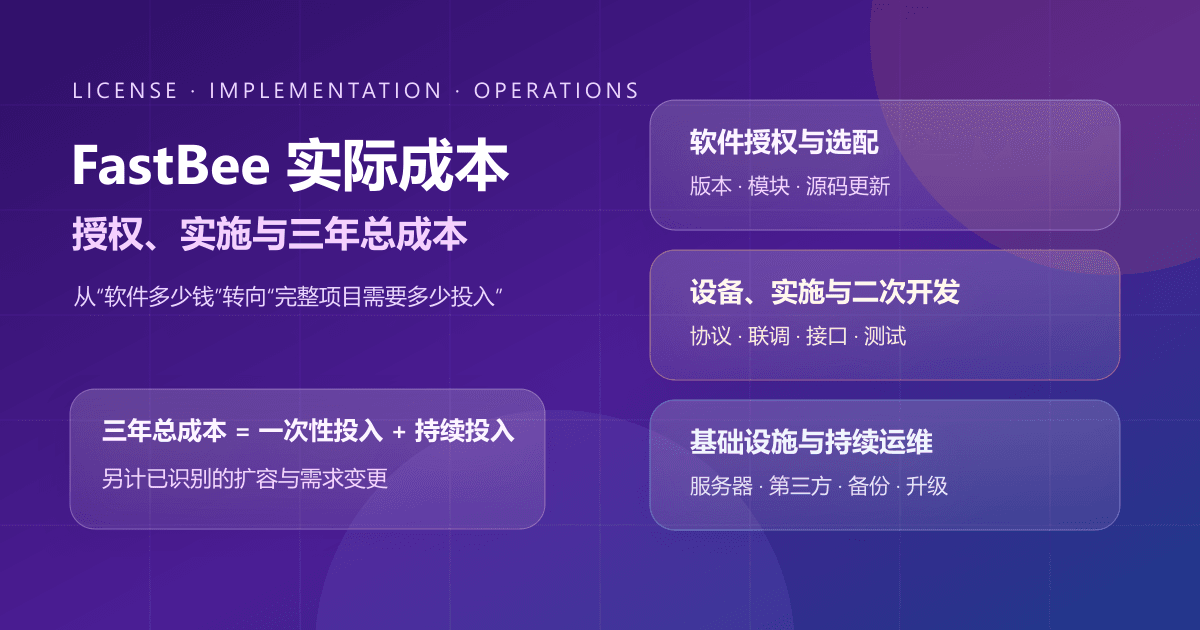
The real cost of using FastBee cannot be determined from the Commercial Edition license price alone. A complete budget normally includes the software edition and optional modules, device and protocol integration, implementation and customization, servers and third-party services, training and operations, and long-term upgrades, scaling, and recovery work.
The Open Source Edition has no license fee, but that does not make a commercial project cost-free. A commercial license includes corresponding source code and services, but it does not automatically include device integration, custom development, or ongoing operations. The reliable approach is to define devices, workflows, and delivery boundaries before calculating three-year total cost, rather than reducing the project to a per-device or software-only price.
1. The total-cost model at a glance

Divide the budget into seven categories:
- Software licensing and options: Commercial Edition, Cluster Edition, Web SCADA, smart speaker, and subsequent source updates.
- Device and protocol integration: gateways, device modification, firmware, protocol adaptation, point tables, and real-device integration.
- Implementation and customization: deployment, configuration, data cleaning, APIs, pages, workflows, testing, and training.
- Infrastructure: servers, storage, bandwidth, backups, monitoring, load balancing, and disaster recovery.
- Third-party services: SMS, maps, weather, AI models, IoT SIM data, and third-party software licenses.
- Ongoing operations: inspections, security fixes, backup recovery, upgrades, scaling, and incident response.
- Risk and change: requirement changes, incomplete private-protocol documentation, weak field networks, data migration, and customization-related upgrade conflicts.
License prices are relatively easy to find; device adaptation, implementation, and ongoing operations are more often underestimated. The last two are particularly important for organizations without an in-house development team. See Can You Use FastBee Without Developers?.
2. Software licensing: separate public prices from delivery boundaries
The Commercial Licensing page is the authoritative source for current public pricing and licensing. The following excerpts reflect its October 31, 2026 update; procurement still requires checking the latest page and contract:
| Item | Public-page policy | Additional budget questions |
|---|---|---|
| Open Source Edition | Free, AGPL v3, non-commercial use | Do not estimate a commercial project as free licensing; implementation and operations still cost money |
| Commercial Edition | CNY 29,000, perpetual license, one year of source updates included | Required modules, source scope, deployment, and customer-delivery boundaries |
| Cluster Edition | CNY 80,000, perpetual license, one year of source updates included | Kafka, load balancing, cluster servers, and operational capabilities |
| Web SCADA | CNY 21,000 optional module | Whether drag-and-drop SCADA is needed rather than standard visualization dashboards |
| Smart speaker | CNY 3,000 optional module | Whether the workflow needs the module and its third-party platform conditions |
| Custom development | Public reference of CNY 1,000–3,000 per day | Requirements, workload, testing, and deliverables |
| Specialized technical support | Public reference of CNY 200–500 per hour | Exact scope for device integration, deployment, mobile publishing, and related work |
Source-update subscriptions and perpetual licensing are separate. A perpetual license does not mean perpetual free access to new versions. Renewal should be based on security fixes, feature needs, and internal maintenance capabilities. Historical quotations, package discounts, and chat messages should not be used as current budget evidence.
3. Devices and protocols: the hardest device drives integration cost
Device quantity affects workload, but protocols and field conditions often matter more. One hundred standard MQTT devices may be easier to integrate than ten private-protocol devices with incomplete documentation.
Assess at least these cost drivers:
| Cost driver | What to confirm | Potential work |
|---|---|---|
| Standard-protocol devices | Protocol versions and authentication for MQTT, Modbus, HTTP, and others | Product configuration, Thing Models, register mapping, and integration |
| Private-protocol devices | Frame structure, byte order, checksums, heartbeat, responses, and examples | Rule Scripts, backend codecs, and malformed-payload testing |
| Legacy non-networked devices | Serial ports, controllers, field buses, and power | Gateways, collection retrofit, field work, and stability validation |
| Device firmware | Whether changes are allowed and whether reconnection, backfill, and OTA are supported | Firmware development, upgrades, and real-device regression |
| Field networking | 4G, Wi-Fi, Ethernet, weak signals, NAT, and outage duration | Network changes, edge buffering, reconnection, and backfill validation |
| Remote control | Permissions, responses, timeouts, interlocks, and failure states | Control-path, safety, and field acceptance testing |
Incomplete protocol documentation calls for sample devices and message analysis before pricing. Do not estimate solely as device count multiplied by a fixed unit price. See the Products and Device Connection FAQ for the evaluation checklist.
4. Implementation and customization: budget more than coding time
Implementation commonly covers environment preparation, deployment, product/device configuration, Thing Models, rules and alerts, permissions, historical data, notifications, visualization, and acceptance. Customization may involve private protocols, APIs, mobile applications, pages, reports, and core workflows.
A complete development task also includes:
- Requirement clarification and field mapping.
- Development environments and private dependencies.
- Coding, review, and testing.
- Real-device and third-party-system integration.
- Build, deployment, documentation, and training.
- Future upstream merges and regression testing.
"Changing one page" is therefore not the same workload as delivering a maintainable business module. Configuration, Rule Scripts, and data bridging can reduce core changes and long-term maintenance. When customization is necessary, complete one small change with an independent build and deployment before estimating the full scope. See the Development, Build, and API FAQ.
5. Infrastructure and third-party services: recurring costs often missed
5.1. Servers and storage
A basic evaluation can start with the documented configuration, while production sizing must account for connections, reporting frequency, retention, video, and query concurrency. A budget may need more than one application server:
- Compute for databases, time-series databases, and Brokers.
- Storage for historical data, recordings, uploads, and backups.
- Public bandwidth, leased lines, VPNs, or intranet changes.
- Test environments, standby recovery environments, and monitoring.
- Kafka, load balancing, and additional nodes for cluster deployments.
5.2. Third-party software and services
A FastBee license does not replace third-party licensing. SMS, voice, maps, weather, AI models, IoT SIM data, object storage, TDengine, and other services require project-specific accounts, permissions, and usage fees.
These costs may grow with calls, traffic, storage, or subscription period. Record free quotas, price sources, and usage assumptions in the budget instead of assuming third-party services are included. See Commercial Licensing for current boundaries.
6. Operations and upgrades: three-year cost is not only the go-live year
Self-hosting assigns ongoing operational responsibility to the project owner. Even without new features, the following work remains:
- Routine inspections, log review, and disk-capacity management.
- Database and file backups, off-site copies, and recovery drills.
- Certificate renewal, account audits, and security fixes.
- Version upgrades, database scripts, regression testing, and rollback.
- New devices, rule changes, permission changes, and user support.
- Scaling or cluster changes when capacity thresholds are reached.
Customized source also requires budget for upstream merges and custom-feature regression. Without internal operators, some work can be outsourced, but response scope and fees must be explicit; maintenance should not be assumed to happen automatically after delivery. See the Self-hosted Deployment Guide.
7. A fill-in three-year TCO worksheet

Compare options against the same business objective, then enter quantities, unit prices, and assumptions. This table can be used directly for internal procurement estimates without inventing amounts:
| Cost item | One-time investment (Year 0) | Annual investment (Years 1–3) | Evidence or assumption to enter |
|---|---|---|---|
| Software edition and optional modules | ¥____ | ¥____ | Current licensing page, contract, and update-subscription needs |
| Servers, storage, and networking | ¥____ | ¥____ | Configuration, quantity, bandwidth, backup, and scaling assumptions |
| Third-party licenses and services | ¥____ | ¥____ | SMS, maps, AI, data, database, and other usage |
| Devices, gateways, and firmware | ¥____ | ¥____ | Device inventory, gateway quantity, retrofit, and spares |
| Protocol adaptation and device integration | ¥____ | ¥____ | Protocol material, sample devices, points, and exception testing |
| Implementation, APIs, and customization | ¥____ | ¥____ | Requirements, person-days, testing, and deliverables |
| Training and operations support | ¥____ | ¥____ | Trainees, inspections, response, and service period |
| Upgrades, backups, and recovery drills | ¥____ | ¥____ | Drill frequency, environments, and staffing |
| Scaling and requirement-change allowance | ¥____ | ¥____ | Growth assumptions and a reviewable allowance |
| Total | ¥____ | ¥____ | Every amount has a source and assumption |
Use this structure to compare options:
Three-year TCO = Year 0 one-time investment + Years 1–3 recurring investment + identified scaling and change costs
Two cautions matter. First, source-update subscriptions should be calculated according to actual needs rather than mechanically treated as mandatory. Second, a risk allowance should correspond to specific risks such as private protocols, weak networks, migration, or customized upgrades—not arbitrary markup.
8. How to reduce cost without removing necessary work
- Validate the hardest device first to reduce protocol and field-network uncertainty before expanding procurement.
- Implement in phases: begin with read-only monitoring and alerts, then evaluate remote control, deep integration, and clustering.
- Prefer standard protocols and configuration to reduce unnecessary private protocols, core changes, and custom pages.
- Reuse device templates and acceptance checklists so similar devices copy proven configurations rather than starting over.
- Keep a real test environment to reduce production trial-and-error, downtime, and rework.
- Include backup and recovery in the initial budget: skipping recovery drills delays cost until a failure rather than eliminating it.
- Compare the same delivery boundaries: quotes are comparable only when devices, features, testing, training, and operations cover the same scope.
Edition choice affects infrastructure and operating costs, so also read the Commercial vs Cluster selection guide. See FastBee Pros and Cons for overall platform fit.
9. FAQ
9.1. Is FastBee Open Source Edition completely free?
It has no license fee, but the official matrix marks it for non-commercial use. Even lawful non-commercial validation can incur server, device integration, implementation, and maintenance costs. Commercial projects must not estimate solely on zero license fees.
9.2. Does a commercial license include every project cost?
No. Licensing defines use and source-delivery boundaries for the relevant edition. Device protocols, customization, third-party services, infrastructure, and ongoing operations require project-specific assessment. Web SCADA and smart speaker are also optional modules.
9.3. Can integration fees be estimated only from device count?
No. Protocols, documentation quality, firmware, networking, point counts, control, and exception acceptance all affect workload. Run a POC with both a standard device and the hardest device before estimating fleet-wide integration.
9.4. Why compare three-year total cost?
Licensing and implementation occur mainly at the start, while servers, third-party services, operations, upgrades, and scaling continue over time. Comparing only initial prices underestimates the long-term responsibilities of self-hosted projects and the real differences between options.