


Using FastBee Without a Development Team
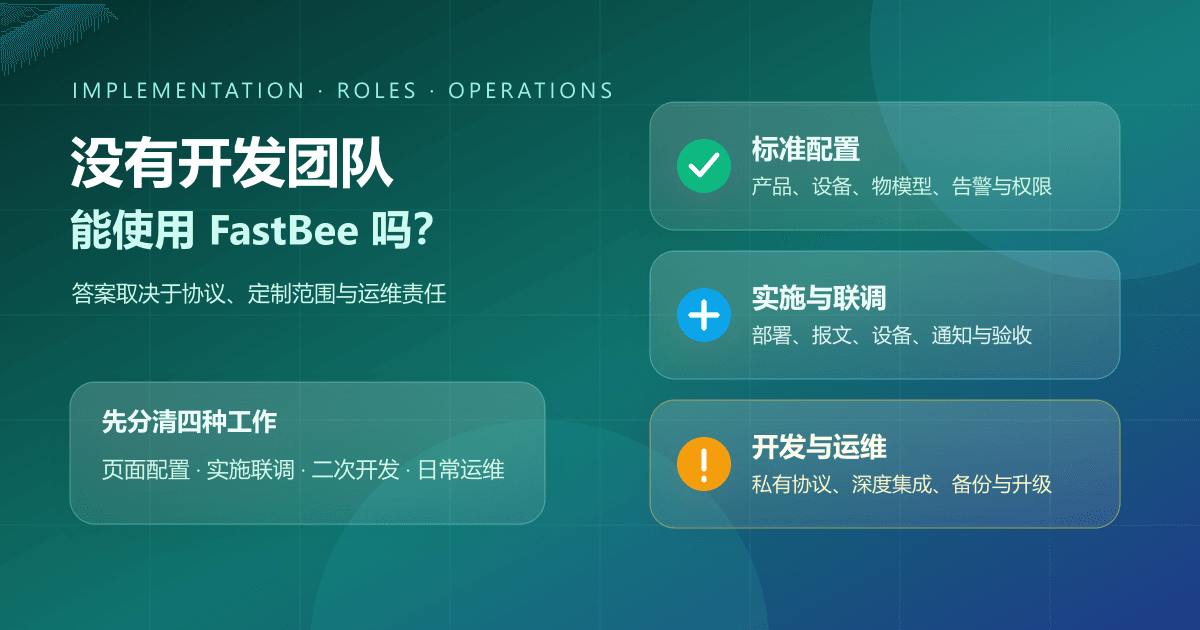
You can use FastBee without an in-house development team, but a standard product does not mean that no technical capability is required. If the project uses standard protocols, relies mainly on configuration, and has reliable implementation and operations support, a non-R&D organization can go live. Private protocols, device firmware, complex integrations, or custom pages require temporary or ongoing development capability.
The more useful question is not simply "Do we have programmers?" It is: who deploys the platform, prepares device documentation, integrates devices, configures permissions and alerts, performs backups and upgrades, and diagnoses data problems? Assigning these responsibilities matters more than labels such as "low-code" or "source code included."
1. A quick assessment by project type
| Project conditions | Feasibility without in-house developers | Required support |
|---|---|---|
| Standard MQTT/Modbus devices with monitoring, alerts, and reports | Relatively feasible | Deployment, device integration, and basic operations |
| Intranet deployment with workflows covered mainly by standard modules | Feasible but requires validation | Network and security configuration, permission design, and backup recovery |
| Private TCP payloads with no firmware changes allowed | Depends on protocol complexity | Protocol analysis, scripting or backend development, and real-device testing |
| ERP/MES or unified-authentication integration | Technical collaboration required | APIs, field mapping, authentication, permissions, and exception handling |
| Highly customized pages, approvals, or industry workflows | Do not estimate as zero-development | Source customization, testing, and future-version maintenance |
| No developers or operators, with a preference for full hosting | Compare cloud or managed operations services | Clear service scope, response boundaries, and pricing |
See FastBee Pros and Cons for overall platform fit. This article breaks down the responsibilities behind the question of whether a non-R&D organization can use it.
2. Work that business or implementation staff can usually perform
Once the platform is deployed, the edition and modules meet requirements, and device documentation is complete, many routine configuration tasks do not require backend coding:
- Create products and devices, and maintain groups, assignments, and basic records.
- Define Thing Model properties, functions, and events from device data.
- Configure runtime status, historical storage, Scene Linkage, and alert rules.
- Configure notification channels, templates, recipients, and alert-handling workflows.
- Create organizations, roles, and users within the permission system.
- Use available reporting, visualization dashboards, mobile applications, or optional SCADA capabilities.
These tasks still require device and business knowledge. Thing Model identifiers must match device payloads, live values are not the same as historical data, and an alert configuration does not prove notification delivery. Non-technical staff can learn these operations, but clickable pages alone do not constitute business acceptance.
See the Platform Module Overview for modules and prerequisites, and follow the Product-to-Device Workflow for the first device chain.
3. Work that cannot rely only on page configuration
3.1. Deployment, networking, and security
A self-hosted project requires servers, Docker or the relevant runtime, and configuration of domains, ports, certificates, databases, reverse proxies, and access control. Even on an intranet, devices, users, and third-party services must each be able to reach the platform; opening a page on the server itself is not enough.
3.2. Private protocols and device firmware
Standard protocols still require register, payload, and authentication configuration. Private protocols may require Rule Scripts or backend codecs. Reconnection, backfill, remote control, and OTA also depend on firmware implementation; enabling a platform option cannot create missing device-side behavior.
Protocol material should include message directions, frame structure, field types, byte order, checksums, heartbeat, responses, and examples. See Protocol Management and the Products and Device Connection FAQ for extension work.
3.3. Deep third-party integration
Reading data, pushing data, and issuing third-party commands are three different paths. Simple delivery may use data bridging, while complex integration involves authentication, field mapping, timeouts, retries, idempotency, permissions, and logs, usually requiring technical staff from both sides.
3.4. Custom pages and core workflows
Changing a name or logo and using standard pages is not the same as redesigning an industry process. Special device panels, complex approvals, custom reports, and new core data models may require frontend, backend, and testing work.
3.5. Upgrades, backups, and recovery
Production systems need owners for backups, recovery drills, security fixes, upgrades, and rollback. Customized source also requires upstream merges and regression testing; an upgrade is not a simple file overwrite.
4. Three implementation paths: configuration, integration, and source customization

| Path | Appropriate requirements | Main capabilities | Typical deliverables |
|---|---|---|---|
| Standard configuration | Standard devices, Thing Models, alerts, permissions, reports, and display | Product implementation, device knowledge, and platform operation | Configuration checklist, device models, rules, and acceptance records |
| Rule and API integration | Payload conversion, HTTP/MQTT delivery, and existing-system integration | Scripting, APIs, networking, authentication, and joint debugging | Scripts, field mappings, API agreements, and exception handling |
| Source customization | Private protocols, custom pages, core workflows, and deep customization | Java/Vue, databases, testing, and version management | Buildable source, tests, deployment packages, and change records |
Evaluate these paths in order: configuration first, rules and APIs second, and core source changes last. This reduces unnecessary customization and future upgrade conflicts. See the Development, Build, and API FAQ and Data Bridging for integration entry points.
5. Roles still required without an R&D team

"No development team" does not mean "no project ownership." A controlled implementation normally needs:
- An internal project owner to confirm goals, scope, priorities, and acceptance criteria rather than leaving external staff to guess requirements.
- A device or site owner to provide manuals, protocols, point tables, network conditions, and a real test environment.
- A platform implementer to deploy the system and configure products, devices, rules, alerts, permissions, and training.
- On-demand developers to handle private protocols, APIs, firmware, or source customization and take responsibility for delivered code.
- An operations owner to perform inspections, backups, recovery, upgrades, and account-permission management.
These roles can belong to different organizations or be combined, but they should not be absent. In particular, the operations owner must participate in hands-on acceptance before delivery rather than receiving only a set of accounts after go-live.
6. Common risks for organizations without developers
6.1. Treating a demo as production acceptance
An online demo shows that features exist; it does not prove that your devices, network, data volume, or third-party services will work. Use representative devices and real workflows for a production POC.
6.2. Writing requirements only as "connect to the platform"
Connection can mean only online status, or it can include history, alerts, remote control, backfill, and OTA. Unclear scope distorts pricing, schedules, and acceptance. Define inputs, outputs, and exception behavior for every device type.
6.3. Excessive customization creating long-term dependence
Changing core source for simple requirements can add merging and testing work to every upstream upgrade. Standard modules and open APIs reduce dependence on particular developers.
6.4. No ownership of backups or account security
Unchanged default passwords, backups that have never been restored, and certificates without renewal ownership turn "live" into a risk. Delivery must validate recovery and permission boundaries, not just pages.
6.5. Comparing only initial implementation prices
A low implementation quote that excludes device integration, training, documentation, support boundaries, and future upgrades can cost more over time. Check cost components against Commercial Licensing and the After-sales Support Boundaries.
7. A POC approach for non-R&D organizations
A POC should not be operated entirely by the vendor. Future users and maintainers should participate and complete these tasks:
| Acceptance task | Who performs it | Pass condition |
|---|---|---|
| Create a product type and define its Thing Model | Internal business or implementation staff | Explain field origins and correct one configuration issue |
| Connect one standard device and the most difficult device | Device owner and implementer | Complete online status, reporting, control, and exception records |
| Configure one real alert | Business user | Trigger, delivery, recovery, and handling records are complete |
| Validate permissions | Platform administrator and ordinary user | The ordinary user sees and operates only the authorized scope |
| Complete a backup restore | Actual operations owner | Restore successfully in an isolated environment and verify business data |
| Diagnose one fault from logs | Actual maintainer | Use timestamps, device details, and logs to identify the failing layer |
| Complete an upgrade drill | Operations owner, with developers if needed | Backup, rollback, and business regression records are complete |
If external developers must perform every critical POC operation, the organization should agree on ongoing support before procurement instead of assuming fully independent maintenance after delivery.
8. How to choose implementation and operations support
Include at least the following in requirements or service agreements:
- Deployment environment, edition, modules, and third-party-service boundaries.
- Device inventory, protocol documentation, point counts, and uplink/downlink requirements.
- What standard configuration, protocol adaptation, API integration, and source customization each include.
- How test environments, real devices, performance, and failure recovery will be accepted.
- Whether training, operating guides, configuration inventories, source code, and deployment packages are included.
- Who owns inspections, backups, security fixes, upgrades, and incident response after go-live.
- How requirement changes, additional devices, and ongoing maintenance affect fees and schedules.
See Commercial Licensing for current official pricing and basic service policies. Project deliverables still require a requirements list and formal agreement; historical chat quotations or service promises are not substitutes for a current contract.
9. FAQ
9.1. Can someone with no technical background deploy FastBee independently?
Independent production deployment should not be the default assumption. Docker documentation supports learning and validation, but production also involves networking, databases, certificates, backups, and security. Arrange implementation and operations support and participate in acceptance.
9.2. Does buying the Commercial Edition eliminate secondary development?
Not necessarily. Standard features can be used directly, but private protocols, special workflows, and deep integration may still require development. The need depends on the gap between your requirements and the current edition's standard capabilities, not on the license itself.
9.3. Does source-code delivery guarantee fully independent maintenance?
Source code enables independent maintenance but still requires build, deployment, database, testing, and version-management capabilities. Without them, retain external support while reducing dependence through standard configuration, documentation, and training.
9.4. Which non-R&D organizations are best suited to FastBee?
Organizations with relatively standard protocols, workflows aligned with existing modules, a need for self-hosting, and a willingness to assign an internal project owner and basic operations owner are more likely to succeed. A real POC remains necessary; organization size alone is not a reliable decision criterion.