


FastBee FAQ: Pricing, Deployment and Protocols
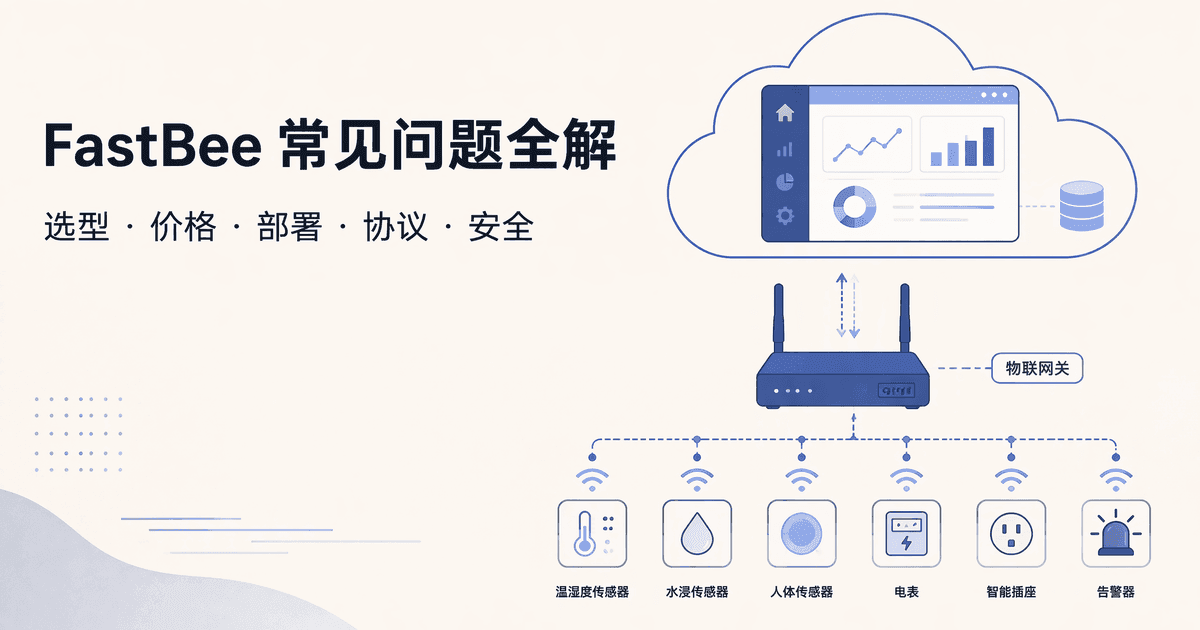
FastBee is an AIoT platform that keeps device connection, data collection, rule engine, visualisation and embedded software on one product path, with private deployment and licensed source-code development. This article collects the five question groups we see most often — edition selection, pricing, deployment, protocols and security. Each question gives a one-line answer first, then the evidence and its boundary, and finally the official documentation entry, so you can check it against your own project.
Unlike a product landing page, everything here comes from official documentation and public release information: pricing and licensing follow the commercial licence page, feature scope follows each version's documentation, and security fixes follow the system vulnerability fixes note.
1. One-line answers to seven common questions
| Question | One-line answer |
|---|---|
| What is FastBee | A private AIoT platform covering device access, data, rules, alerting, visualisation and multi-client apps, with a built-in MQTT broker |
| Open source vs business edition | The open-source edition is for non-commercial use (AGPL 3.0); the business edition adds full protocols, operations modules and licensed source code |
| Business edition pricing | Business edition 29,000 CNY and cluster edition 80,000 CNY, both perpetual with one year of source updates |
| How to deploy | Deploy with Docker and docker-compose, then upload the licence certificate to activate the platform |
| Which protocols | MQTT and GB28181 are shared capabilities; the business edition adds TCP, UDP, CoAP, HTTP, Modbus, JT808 and more |
| How to choose against ThingsBoard | Prefer FastBee when you need private delivery, licensed source and domestic protocol coverage; compare first for pure standard thing-model cases |
| Which scale needs the cluster edition | Large-scale device access with horizontal scaling, accepting the Kafka and load-balancing operations that come with it |
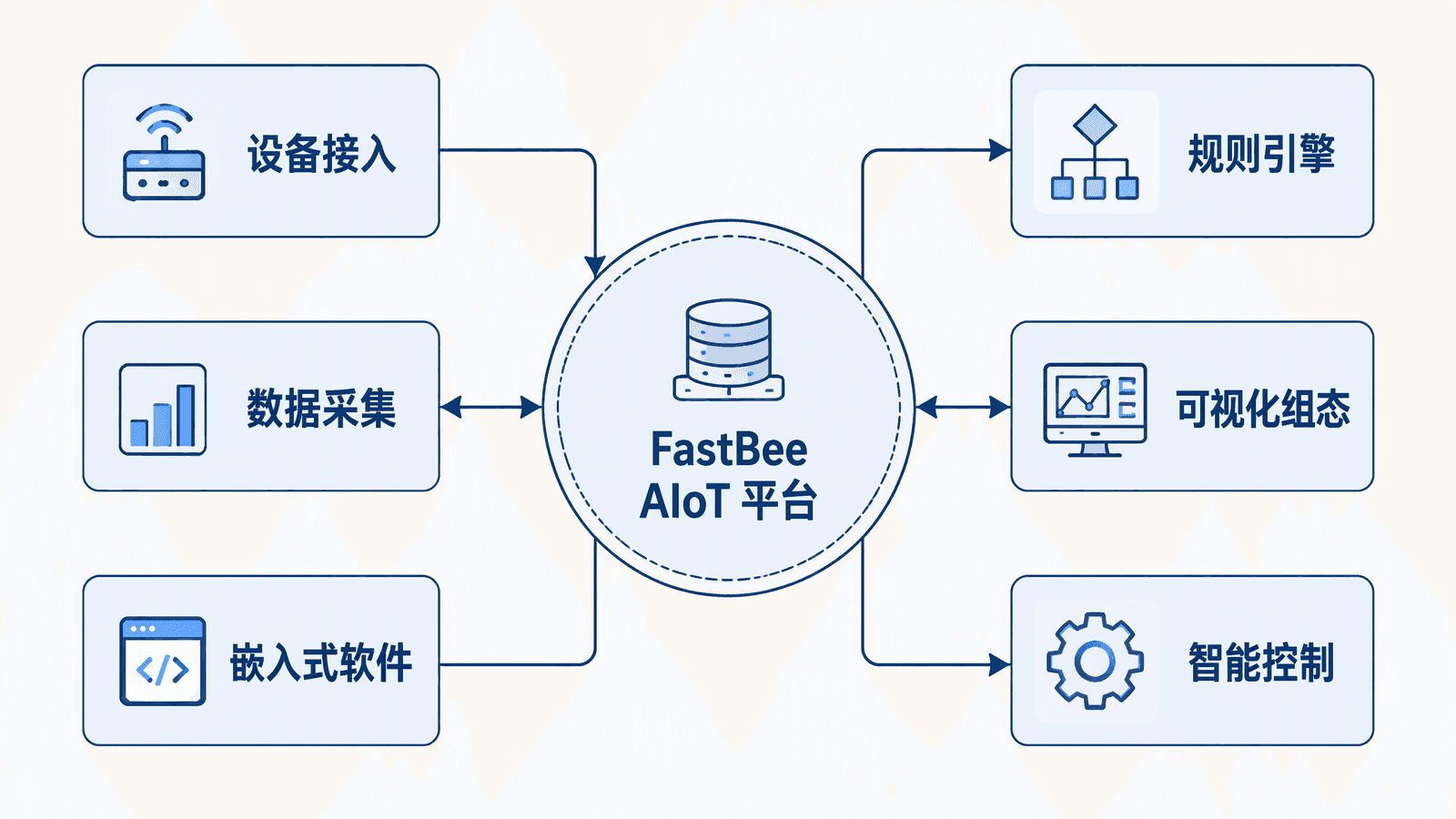
The capability overview above maps the six core areas: device connection, data collection, rule engine, visual SCADA, intelligent control and embedded software. The rest of this article answers the questions in detail.
2. FAQ
1. What is FastBee and what problem does it solve?
FastBee is an AIoT platform maintained by Qujing FastBee Technology Co., Ltd. It solves the "device to business closure" problem: devices connect over MQTT, Modbus, JT808 and other protocols, their data enters a unified thing model, and rule engine, scene linkage, alert notifications and visual SCADA then drive the business process, with mobile apps and reports closing the delivery loop. The open-source edition ships a Netty-based MQTT broker, so protocol testing works without deploying EMQX separately.
Typical use cases are industrial, energy, agriculture and campus projects that need private deployment and data autonomy. The limits are equally explicit: if you have no technical resource at all, want the platform fully managed and consumption-priced, or have requirements far from the supported protocols and business model, evaluate the implementation cost before choosing a platform. See the open-source documentation and business documentation for the current capability list.
2. How do the open-source and business editions differ, and what does the business edition cost?
The two editions are not the same product with features switched off; the difference is licence and usage boundary. The open-source edition uses the AGPL 3.0 licence and targets non-commercial use; commercial use requires a business or cluster licence.
Per the public wording on the commercial licence page (updated 2026-10-31):
| Edition or module | Licence fee | Subscription renewal |
|---|---|---|
| Business edition | 29,000 CNY | 8.5-11k CNY/year |
| Cluster edition | 80,000 CNY | 20k CNY/year |
| Web SCADA module | 21,000 CNY | 5k CNY/year |
| Smart speaker module | 3,000 CNY | none |
All three are perpetual licences and include one year of source updates; renewals for licensed users are 30-40% of list price, and an expired period must be paid as an incremental difference. Functionally, the business edition adds TCP, UDP, CoAP, HTTP and other protocols, data bridging, alerting, scene linkage, the visual rule designer, work orders, OTA, reports, dashboards and multi-tenancy on top of the open-source edition; SCADA management and Xiaodu speaker integration are optional modules. The full module comparison remains the table on the commercial licence page.
3. How do I deploy FastBee with Docker?
The business edition is recommended to deploy with Docker: prepare a Linux server with Docker and Docker Compose, upload the repository's docker/data/ directory to /var/ on the server (for the business edition, repackage the back end and front end into /var/data/java/ and /var/data/nginx/vue/), run docker-compose up -d from /var/data/ and wait for the services to start, then open the platform page and sign in with the default account; the EMQX console is reachable on port 18083. After deployment you must configure the licence, otherwise the home page stays unavailable. When you redeploy after secondary development, only the backend jar and the front-end vue directory need replacing; the full procedure is in quick deployment.
The open-source edition can be started quickly through the Docker one-click path, with connection details in MQTT access; check environment dependencies against deployment and upgrades before you start.
4. Which protocols and devices does FastBee support?
MQTT and GB28181 (national-standard video access) are shared by both editions: the open-source edition includes the MQTT broker and supports JSON and JSONOBJECT message protocols, rule scripts, multiple data sources and time-series databases. The business edition adds TCP, UDP, CoAP and HTTP together with industrial and automotive protocols such as Modbus and JT808, plus device maintenance, data bridging, recording management and cloud-to-cloud integration.
A protocol name in a feature table only means an access path exists; it does not mean any device connects with zero configuration. Modbus still requires registers, data types, byte order and polling; a private TCP protocol still requires frame structure, heartbeat, packet splitting and responses; video still requires codec, network, bandwidth and playback validation. Before integration, walk through the checklist in the device access FAQ and then verify real up/down traffic with the device connection documentation.
5. How do I choose between FastBee, ThingsBoard and JetLinks?
The decision point is not "who has more features" but delivery model and control: projects that need private deployment, licensed source for secondary development, domestic notification channels and a combination of industrial protocols have a lower adaptation cost with FastBee; projects that only need a standard thing model, accept running the platform themselves and do not care about source code can evaluate managed cloud services or purely open-source options in parallel.
FastBee's differences concentrate in three places: a built-in MQTT broker that reduces peripheral components, domestic protocol and multi-client coverage that reduces integration work, and licensed source that makes business adaptation easier. For a side-by-side view, read the articles already published on this site — the 2026 comparison of domestic open-source IoT platforms and the ThingsBoard alternative — both of which state each platform's boundary rather than recommending one direction only.
6. Which project scale needs the cluster edition?
The cluster edition targets large-scale device access: it has the same features as the business edition and differs in device capacity and deployment topology. The cost is higher operations complexity — Kafka, load balancing and further components must be prepared, and scaling, failure drills and monitoring become your responsibility. The criterion is therefore not "are there enough devices" but whether the team can operate a cluster and whether the business accepts the extra component dependencies; see the cluster documentation for deployment and usage.
Size the platform with a real load test: run one validation with near-production concurrent connections, message frequency and retention period before choosing the business or cluster edition, instead of ordering based on marketing numbers.
7. Has FastBee had security vulnerabilities, and how are issues handled?
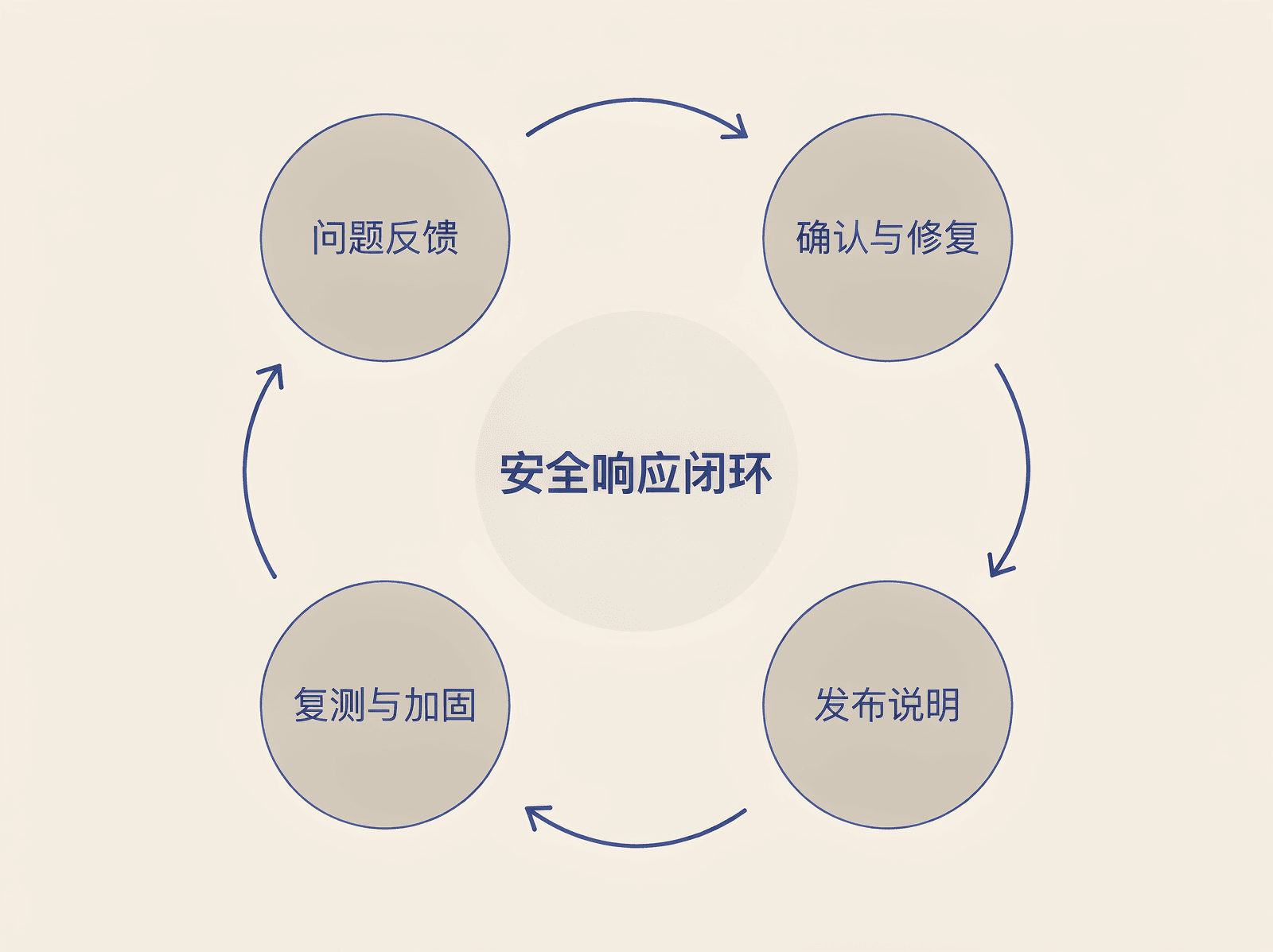
No maintainable platform should promise it has no vulnerabilities; what FastBee does is close the loop — receive a report, confirm and fix, publish a note, then retest and harden. Disclosed issues and remediation guidance are collected in the system vulnerability fixes note; conclusions circulating on third-party channels are not the official position.
If you suspect a problem, follow the troubleshooting page to collect the product layer, version number and a minimal reproduction, then report it through the issue tracker, the enterprise user groups or online support so it can be located quickly. Once fixed, the change appears in the release notes, which you can check against your current version in the release notes.
3. Edition selection path
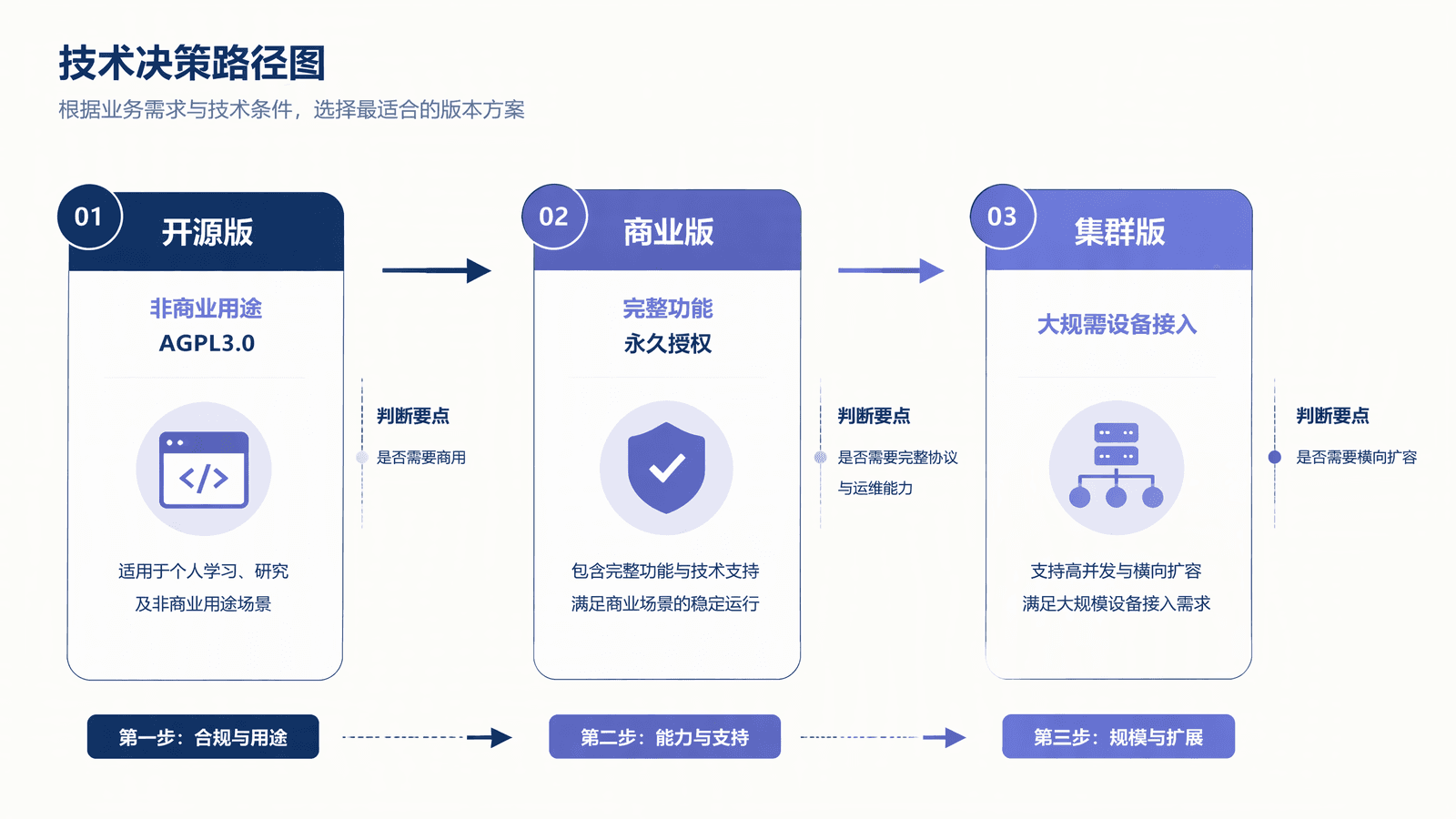
Walking the questions above in order usually converges in three steps:
- Compliance and usage: use the open-source edition for non-commercial learning and validation; if the use is commercial, the open-source edition is off the table.
- Capability and support: choose the business edition when you need the full protocol set, data bridging, alerting, work orders, reports or licensed source.
- Scale and expansion: evaluate the cluster edition and the cost of horizontal scaling only when device volume, concurrency or availability outgrow the current topology.
Each step takes real business input: settle the licence scope first, then confirm the protocol and device list, and finally validate capacity with load tests and failure drills — not by working backwards from a feature list.
4. Common misconceptions and boundaries
- Treating the open-source edition as a free commercial platform: it is for non-commercial use, and commercial use needs a licence — the most common compliance mistake.
- Equating "source code provided" with "zero-cost customisation": controllable source lowers the adaptation barrier, but private protocols, business processes and later upgrades still need engineering and testing effort.
- Reading a feature table without version boundaries: protocol and module scope differs per version, and a feature name existing does not mean your version includes it.
- Ignoring deployment and operations responsibility: whether the platform is out-of-the-box depends on environment preparation, device integration and who owns fault triage.
- Using historical quotes for procurement: pricing and licence wording follow the current commercial licence page; third-party articles and past discounts are not a basis.
5. Next steps and further reading
- Try it first: follow quick start through one device connection, then read the device access FAQ.
- Selecting an edition: compare the commercial licence with the business documentation and settle the edition and licence scope.
- Focused on security: read the system vulnerability fixes note and the release notes.
- Judging total cost: continue with the FastBee total cost breakdown and FastBee pros and cons.
6. Summary in one sentence
FastBee selection reduces to three sentences: use case decides the licence, protocols and modules decide the edition, and a real load test decides single-node or cluster; every remaining detail can be checked directly against the matching official documentation page.