

Data Collection and Remote Control Reference Solution
Page Guide
1. Solution Overview
Device networking in industrial settings commonly faces four pain points: device brands and protocols vary widely and data sits in isolated silos; manual inspection is costly, with operating parameters recorded by reading meters; faults are only discovered after the fact, with no early warning; and on-site start/stop depends on staff being physically present, leaving no way to respond remotely.
This solution centers on the FastBee IoT platform. Workshop devices are connected uniformly through IoT gateways, and thing models abstract different devices into unified properties, methods, and events. On top of this, the platform provides data collection, remote control, scene linkage, alarm notification, and visual management capabilities. The platform supports on-premises deployment, so data never leaves the plant, making it suitable for manufacturers with requirements for data security and intranet operation.
2. System Architecture
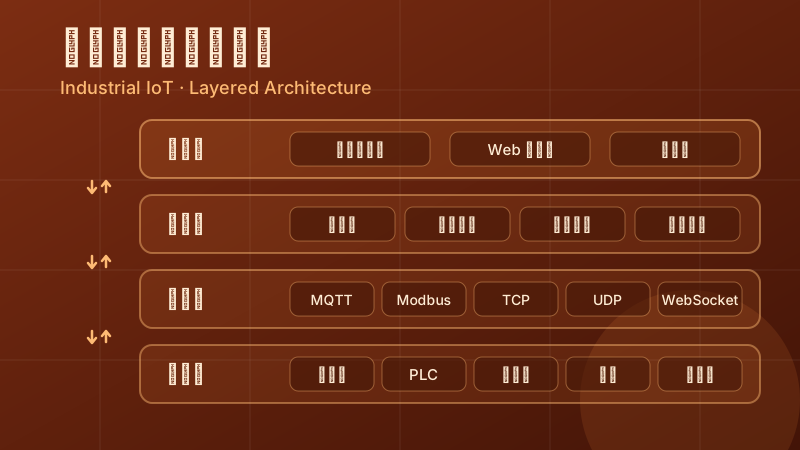
The solution adopts a four-layer architecture, from bottom to top:
- Device layer: machine tools, PLCs, variable-frequency drives, instruments and meters, temperature-humidity and current sensors, and other field devices, as well as network cameras connected via GB28181.
- Access layer: IoT gateways handle protocol conversion and data aggregation, supporting common protocols such as MQTT, Modbus, TCP, UDP, and WebSocket, and support visual programming to implement custom collection logic.
- Platform layer: the FastBee platform provides core capabilities such as thing model management, device management, scene linkage, alarm notification, scheduled tasks, and report statistics.
- Application layer: visualization dashboards, a Web management console, and a mobile app for different roles, so managers can keep track of device status whether in the office or away from the site.
3. Core Features
3.1. Data Collection
Collection points and reporting cycles are defined per product. The gateway converts field registers and sensor readings into platform properties and reports them in real time. Real-time values and historical curves can be viewed, and properties can be statistically analyzed into reports.
3.2. Remote Control
Through device methods defined in the thing model, control commands such as start/stop and parameter settings can be delivered to devices from the Web console or mobile app. The device's generic interface supports drag-and-drop layout, so monitoring panels can be organized according to workshop habits. Both control and reporting leave device logs for traceability.
3.3. Scene Linkage
Automation rules are configured as "trigger condition → execution action" — for example, automatically starting a fan when the temperature exceeds a threshold, or stopping a machine and notifying the on-duty staff when the current is abnormal. Rules are configured visually on the platform, with no need to modify device programs.
3.4. Alarm Notification
Thresholds and alarm levels are set for key properties. Once triggered, alarms are pushed through platform messages and notification channels. Alarm records are kept on file and support acknowledgment and closed-loop handling, preventing anomalies from being missed during inspections.
3.5. Visualization Dashboard
Device distribution, real-time parameters, alarm activity, and statistics are organized into a large-screen dashboard for the workshop control room or showroom, with dashboard data synchronized with the platform in real time.
3.6. Mobile App and Reports
The mobile app lets staff view device status, receive alarms, and perform remote control, which suits on-duty and inspection scenarios. The platform provides statistical analysis and reports on reported properties, supporting energy consumption and operation reviews.
4. Device Access
4.1. Gateways and Protocols
Field devices connect to the platform through IoT gateways: Modbus devices can be attached via RS485 serial ports; controllers with Ethernet ports connect over TCP or UDP; third-party subsystems integrate over MQTT and WebSocket. The gateway side supports visual programming, enabling custom logic such as unit conversion and threshold preprocessing at the edge. For protocol selection background, see Comparing Common IoT Communication Protocols; for edge-side design thinking, see Applying Edge Computing in IoT Systems.
4.2. Thing Model Modeling
Devices of the same type are modeled on the platform as one product, with a thing model attached to the product: properties describe readable and writable state quantities (such as temperature, rotation speed, and running status), methods describe deliverable actions (such as start/stop and reset), and events describe anomalies the device reports proactively (such as fault codes). A new device only needs to be bound to the product to inherit the full set of point definitions.
4.3. Scene Linkage Configuration

Take "automatically start the fan when the temperature exceeds the threshold" as an example: the temperature sensor reports properties on a cycle, the rule engine evaluates whether the trigger condition is met, and if so, delivers a control command to the actuator, with an alarm notification optionally appended. For more on designing linkage rules, see Rule Engine and Scene Linkage in Practice.
5. Deployment and Implementation
The solution is rolled out in the following steps. The overall pace can start with a pilot in a single workshop and then expand to the whole plant:
- Environment preparation: confirm server or industrial PC resources, the plant network, and gateway installation locations; plan the device list and point table.
- Platform deployment: deploy the FastBee platform on premises on a plant server, and complete basic configuration and user role assignment.
- Gateway installation: install IoT gateways by area, complete wiring and network configuration, and verify device communication one by one.
- Modeling and access: create products and thing models by device type, bind devices, and verify property reporting and command delivery.
- Rule configuration: configure scene linkage, alarm thresholds, and notification methods, and jointly debug typical operating conditions.
- Application launch: build the visualization dashboard, enable mobile app access, organize a trial run, collect feedback, and then roll out.
6. FAQ
Which industrial protocols does FastBee support for access?
IoT gateways support MQTT, Modbus, TCP, UDP, WebSocket, and other protocols, and support visual programming for custom collection and conversion logic. Common PLCs, variable-frequency drives, instruments, and sensors can all be connected; video surveillance devices are connected via the GB28181 national standard.
Will an unstable field network affect usage?
The platform is deployed on premises inside the plant, and collection and control mainly run over the plant LAN, with no dependence on the public internet. For critical safety loops, it is still recommended to keep local hardwired interlocks, with platform remote control as an auxiliary means, in line with industrial safety practice.
How does remote control prevent misoperation?
The platform assigns device operation permissions by user role, and both control commands and property reporting are recorded in device logs for traceability. For high-risk actions, confirmation steps or conditional constraints can be added in the thing model and linkage rules.
How long does implementation of this solution take?
Taking a single-workshop pilot as an example, platform deployment and gateway installation are usually completed within a few days; the main workload lies in point verification and joint debugging of linkage rules. The better the point table is prepared, the faster access and debugging go. For the real-world form after rollout, see Verified Projects and Demo Cases.