
Cache Table Schema
1. Table Schema
| Table | Purpose |
|---|---|
| fb_actions | Actions |
| fb_connector | Connectors |
| fb_rules | Rule Engine |
| fb_converter | Transformer Configuration |
| fb_downward | Downlink Settings |
Kafka is a distributed event-streaming middleware that enables real-time data transfer between business systems and applications.
Kafka can serve as a bridge for edge IoT communication. Kafka is divided into producers and consumers, and establishing clients requires a stable network connection. In the IoT field, data generated by devices and applications is transmitted using the lightweight MQTT protocol. Kafka integration enables users to seamlessly stream MQTT data into or out of Kafka. MQTT data streams are introduced into Kafka topics, and MQTT and Kafka topics can be mapped to each other, ensuring real-time processing, storage, and analysis. Data from Kafka topics can also be consumed by MQTT devices for timely processing.
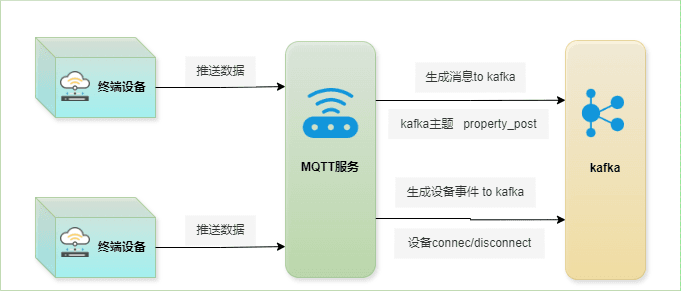
A simple implementation of the MQTT–Kafka data integration flow is shown below.
2. Implementation Flow and Principle
Integrating Kafka data into MQTT is a feature that can be implemented through configuration. Of course, we need to install the Kafka service first. It bridges MQTT-based IoT data and Kafka's powerful data-processing capabilities. Through the built-in rule engine component, the integration simplifies the data flow and processing between the two platforms without complex coding.
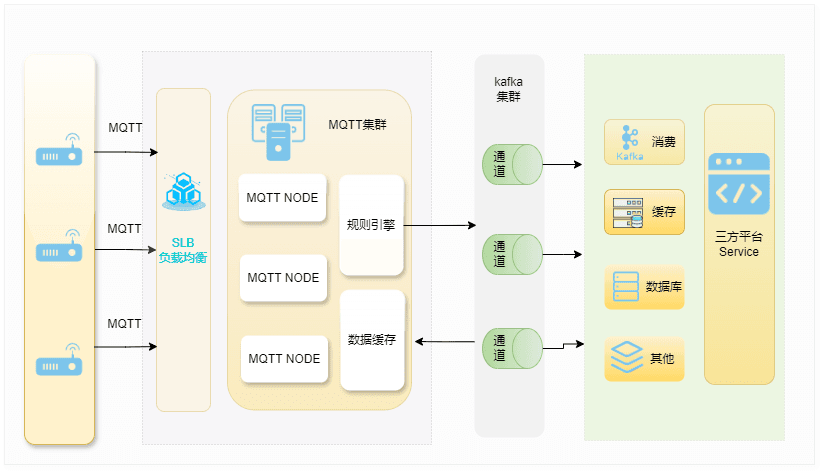
The following figure shows the best-practice architecture for implementing MQTT–Kafka data integration.