


JSON Array and TCP Terminal Access
This page is organized from an existing operations manual as an online operations reference. Operations marked as expected or not executed in the original must still be verified against the actual environment.
Verify item by item the send/receive, independent properties, history, and stop/recovery specified in this guide; after the send/receive, separately check the current publish synchronization.
Before starting: you have product, device, model, publish, control, and history permissions; the local application, single-node FMQ, and FMQX Web are available; and the connection parameters for this device have been obtained
Before You Start
This guide uses TCP with JSON array to verify temperature reporting, setpoint control, independent status reporting, historical data, and stop/recovery.
The first-time configuration screenshots follow the original tutorial; this round reuses the retained product, device, and session. The connection parameters and existing subscriptions are read-only checks performed after the send/receive ended; nothing was re-imported, re-saved, or re-subscribed.
This round's samples came first, and the current publish synchronization supplementary check came after; the two pieces of evidence are described separately. A full business re-verification after the current publish is still pending, so do not claim that this draft has been fully accepted.
FMQX Web is used to demonstrate device send/receive and execution replies; whether the physical device actually actuates still needs confirmation on the device side.
Replace These Parameters Before Copying the Templates
The code in this guide uses plain template names; the screenshots retain the actual historical resources. Complete the following checks before saving as a UTF-8 file or sending a message.
- A JSON array element id is a property identifier and stays the same for the same property; only modify value, and do not change the property id for each message.
- temperature and setpoint are the template property identifiers for temperature and setpoint temperature; they can be kept when generating a Thing Model for the first time, but must be replaced with the real identifiers of that product when reusing an existing product, and all messages and initialState keys must be updated accordingly.
- demo-device is the Device Number template. Replace the device number in clientId, the device number in every send/receive topic, and the clientId of TCP reporting together with the platform's device number for this device; the product ID and tenant ID in the MQTT identity must also be replaced with the current device connection parameters.
- The host, port, and listen direction in the connection file must be changed to the actual addresses of the current environment; 127.0.0.1 means the local machine running FMQX. When MQTT is involved, also check the product ID, username, subscription topics, and responseRoute; the password is entered securely only on the connection page.
- Group, session, and subscription ids are internal references of the import file; if renaming is needed, groupId must match the corresponding group id. Check before importing, and do not create a connection with the same name again on a retained session.
- The code blocks are customer templates rewritten from existing password-free assets or original code; this version of the template has not yet been proven to import successfully. Historical screenshots, send times, and the scope of business passes still follow the records of each step; do not treat template names as the actual resource names in old evidence.
1. First-Time Creation and Configuration Example
If the resources of this guide already exist, reuse them directly without recreating. The following eight steps retain the screenshots and boundaries of the original first-time configuration.
Wizard object samplejson
{

  "temperature": 20,

  "setpoint": 30

}Generate two fields first, then switch to the formal JSON array/TCP. Replaceable customer template names are used here; check against the replacement list in this section before importing or sending.
1. First-Time Configuration · Example: Select New Product
Location: IoT*→Device Access→*Access Source Steps: Select New Product and fill in the name of this guide; for re-acceptance, directly reuse the retained product.
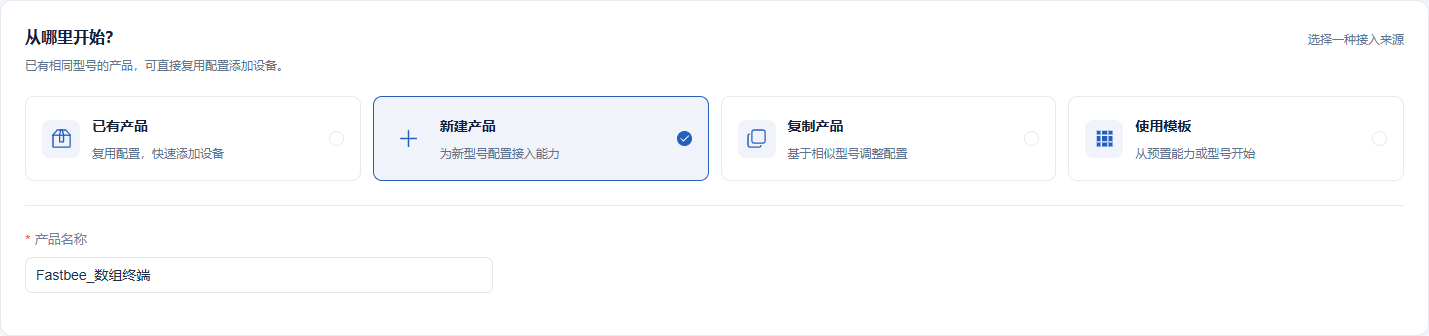
This image retakes the creation entry; creation was not submitted repeatedly, and subsequent devices and history follow the resources of this guide.
Screenshot Key Points
| Field / Control | Description |
|---|---|
| Access Source | Create a new independent product in this guide; re-verification directly reuses the retained resource. Required · Fill in: New Product |
| Product/Device Name | Use a short business name to locate this guide's product and device. Required · Fill in: FastBee_数组终端 |
Expected result (not executed): as shown in the historical screenshot: this image retakes the creation entry; creation was not submitted repeatedly, and subsequent devices and history follow the resources of this guide. Risk and recovery: re-prepare after checking this guide's identity, format, and parameters.
2. First-Time Configuration · Example: Generate Two Fields from the Object Sample
Location: Device Access*→*Collect Data Steps: Fill in the object sample below and parse it, then check temperature and setpoint.

This image only retakes the form; after creation, it is formally switched to JSON array and TCP.
Screenshot Key Points
| Field / Control | Description |
|---|---|
| Wizard JSON Object Sample | First generate two fields from the object, then switch to JSON array/TCP in the product details. Required · Fill in: {"FastBee_temperature":20,"FastBee_setpoint":30} |
Expected result (not executed): as shown in the historical screenshot: this image only retakes the form; after creation, it is formally switched to JSON array and TCP.
3. First-Time Configuration · Example: Check Fields, Integer Type, and Units
Location: Device Access*→*Collection Fields Steps: Check the two field identifiers, integer type, ℃, and paths.
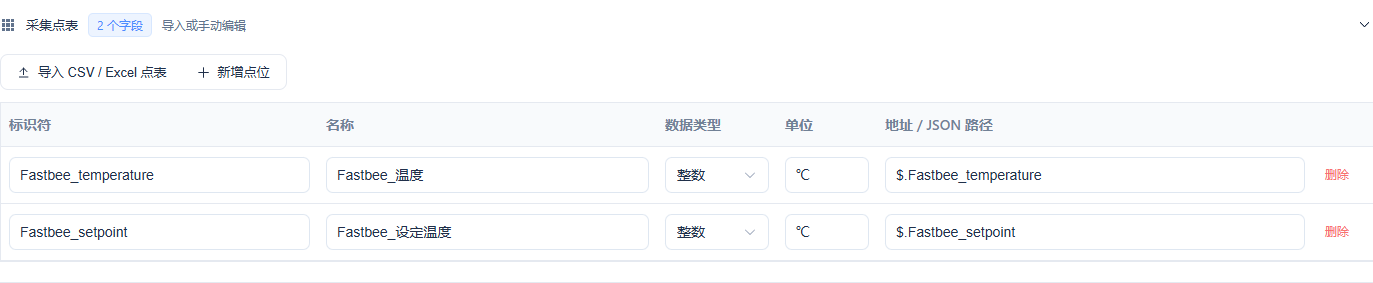
The two properties correspond one to one.
Screenshot Key Points
| Field / Control | Description |
|---|---|
| Fields, Types, Units, and Paths | Two integer properties correspond one to one, ℃. Required · Fill in: FastBee_temperature, FastBee_setpoint; integer; ℃ |
Expected result (not executed): as shown in the historical screenshot: the two properties correspond one to one.
4. First-Time Configuration · Example: Fill in the Independent Device Identifier
Location: Device Access*→*Add Device Steps: Fill in the device number and name.

The reporting clientId always matches this device number.
Screenshot Key Points
| Field / Control | Description |
|---|---|
| Device Identifier | Matches the clientId of every report; the FMQX session id cannot be used as a substitute. Required · Fill in: FastBee_ArrayTCP_Tutorial_01 |
| Product/Device Name | Use a short business name to locate this guide's product and device. Required · Fill in: FastBee_数组终端 |
Expected result (not executed): as shown in the historical screenshot: the reporting clientId always matches this device number. Risk and recovery: stop repeated commands, check this guide's identity, format, model, and actual send/receive; after recovery, report status first.
5. First-Time Configuration · Example: Check the Initial Access Overview
Location: Device Access*→*Confirm Access Configuration Steps: Check 1 device, 2 fields and then create.

Real initial JSON/MQTT; change to the formal JSON array/TCP in the next step.
Screenshot Key Points
| Field / Control | Description |
|---|---|
| Initial Access Overview | 1 device, 2 fields; the wizard starts with JSON/MQTT, and the formal format is changed afterward. Required · Fill in: 1 device, 2 fields |
Expected result (not executed): as shown in the historical screenshot: real initial JSON/MQTT; change to the formal JSON array/TCP in the next step.
6. First-Time Configuration · Example: Select the Formal JSON Array and TCP
Location: Product Management*→*Product Information Steps: Select JSON Array for Data Format and TCP for Transport, then save.
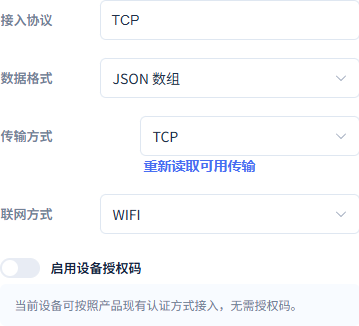
Formal JSON_ARRAY/TCP; WIFI is the network type, not the protocol entry.
Screenshot Key Points
| Field / Control | Description |
|---|---|
| Data Format | This guide's formal JSON array. Other formats belong to separate scenarios. Required · Fill in: JSON Array |
| Transport | Select TCP; the device actively connects to the FMQ listen entry and does not use MQTT topics. Required · Fill in: TCP |
| Network Type | Keep this guide's WIFI; do not treat it as the TCP entry configuration. Required · Fill in: WIFI |
Expected result (not executed): as shown in the historical screenshot: formal JSON_ARRAY/TCP; WIFI is the network type, not the protocol entry.
7. First-Time Configuration · Example: Save the Writable Setpoint and History
Location: Product Management*→Function Definition→*Setpoint Steps: Add Setpoint, uncheck read-only, enable history, then Modify to save.
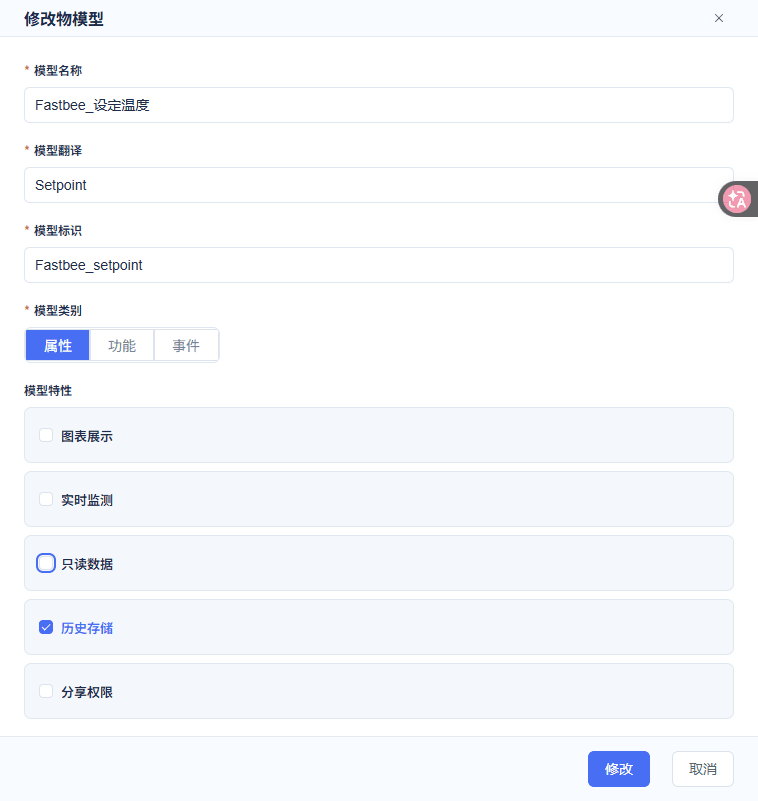
Setpoint 16~35℃, step 1, writable with history enabled.
Screenshot Key Points
| Field / Control | Description |
|---|---|
| Model Translation | Complete the English names, then Modify to save. Required · Fill in: Temperature/Setpoint |
| Model Identifier | The ids of the data array elements must match the identifiers verbatim. Required · Fill in: FastBee_temperature/FastBee_setpoint |
| Model Category | Both are properties. Required · Fill in: Property |
| Read-only Data | Temperature checked, setpoint unchecked. Required · Fill in: Temperature read-only; setpoint writable |
| History Storage | Enabled for both properties. Required · Fill in: Checked |
| Chart Display/Real-time Monitoring | Temperature on, setpoint off. Required · Fill in: Temperature on, setpoint off |
| Share Permission | This guide stays within its tenant scope. Required · Fill in: Unchecked |
| Integer Range, Unit, Step | Temperature -40~100℃, setpoint 16~35℃, step 1, formula left empty. Required · Fill in: Integer; ℃; step 1 |
| Modify/Cancel | Modify to save; Cancel does not submit. Required · Fill in: Modify |
Expected result (not executed): as shown in the historical screenshot: setpoint 16~35℃, step 1, writable with history enabled.
8. First-Time Configuration · Example: Save the Read-only Temperature and History
Location: Product Management*→Function Definition→*Temperature Steps: Add Temperature, keep read-only and history, then Modify to save.
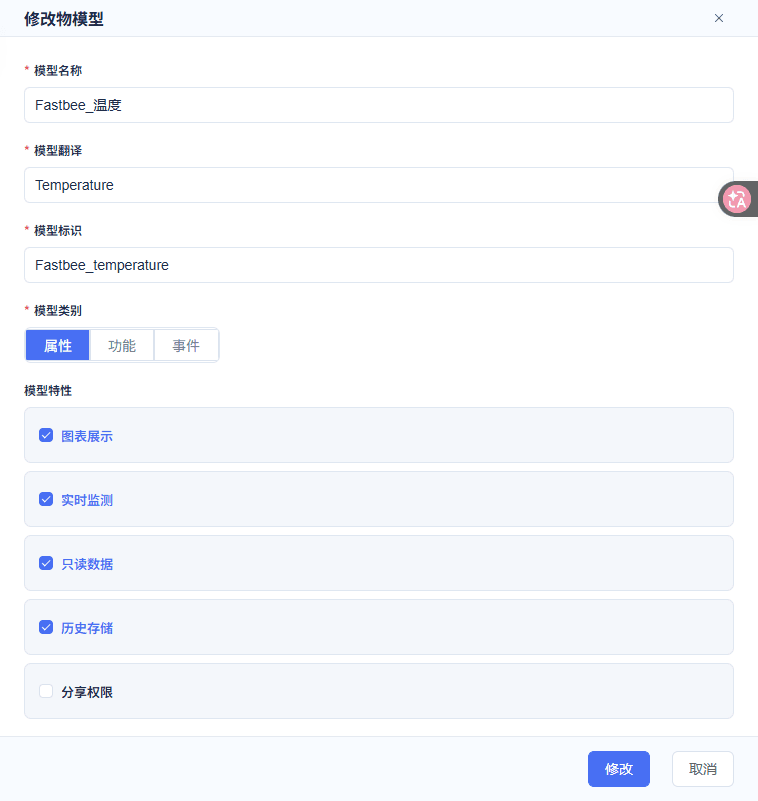
Temperature -40~100℃, chart and real-time monitoring enabled.
Screenshot Key Points
| Field / Control | Description |
|---|---|
| Model Translation | Complete the English names, then Modify to save. Required · Fill in: Temperature/Setpoint |
| Read-only Data | Temperature checked, setpoint unchecked. Required · Fill in: Temperature read-only; setpoint writable |
| History Storage | Enabled for both properties. Required · Fill in: Checked |
| Chart Display/Real-time Monitoring | Temperature on, setpoint off. Required · Fill in: Temperature on, setpoint off |
| Share Permission | This guide stays within its tenant scope. Required · Fill in: Unchecked |
| Integer Range, Unit, Step | Temperature -40~100℃, setpoint 16~35℃, step 1, formula left empty. Required · Fill in: Integer; ℃; step 1 |
| Modify/Cancel | Modify to save; Cancel does not submit. Required · Fill in: Modify |
Expected result (not executed): as shown in the historical screenshot: temperature -40~100℃, chart and real-time monitoring enabled.
2. Reuse and Check the Device Session
**First-time import configuration template (no password)**json
{

  "schemaVersion": 3,

  "groups": [

    {

      "id": "tutorial_demo-device",

      "name": "数组TCP教程",

      "sortOrder": 55,

      "isSystem": false

    }

  ],

  "sessions": [

    {

      "id": "import_demo-device",

      "groupId": "tutorial_demo-device",

      "name": "数组终端",

      "protocol": "TCP",

      "transport": "TCP",

      "host": "127.0.0.1",

      "port": 8888,

      "clientId": "demo-device",

      "autoReconnect": false,

      "tcpLineMode": false,

      "jsonDevice": {

        "format": "JSON_ARRAY",

        "responseRoute": "",

        "initialState": {

          "temperature": 29,

          "setpoint": 30

        }

      }

    }

  ]

}This round did not re-import; the password is obtained by authorized personnel from the device connection parameters and entered securely, and is not written into the manual. Replaceable customer template names are used here; check against the replacement list in this section before importing or sending.
9. First-Time Configuration · Example: Import This Guide's Session
Location: FMQX Web*→Configuration File→*Import Configuration Steps: On first use, open the import entry and select the configuration file; if this guide's session already exists, reuse it directly.
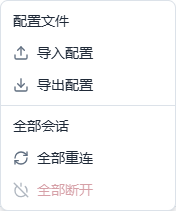
Use the array TCP tutorial's independent group and session; do not borrow the MQTT session.
Screenshot Key Points
| Field / Control | Description |
|---|---|
| Configuration File/Import Configuration | Import this guide's UTF-8 configuration without credentials. Required · Fill in: 数组TCP教程/数组终端 |
Expected result (not executed): the historical entry image is used to show the location; this session's parameters are checked separately in the next step. Risk and recovery: stop repeated sending, check this guide's device identity, data format, and target address; after reconnecting, independently report the current status first, then decide whether to control again.
10. Check the Current Connection Parameters
Location: FMQX Web*→This Guide's Session→*Connection Configuration Steps: Open the connection configuration and check the name, address, port, and device identity.
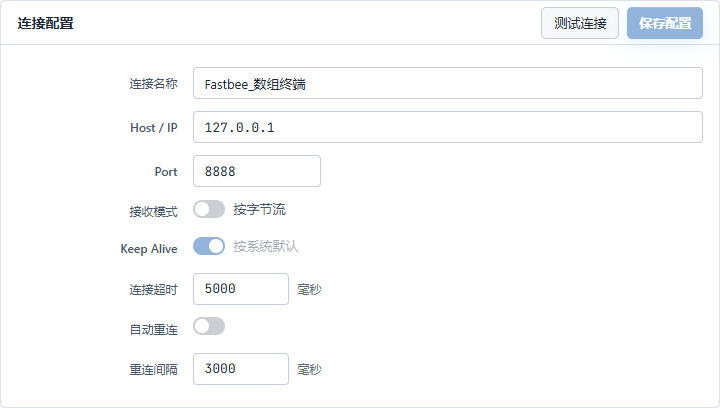
This guide's TCP connection parameters and receive mode
Screenshot Key Points
| Field / Control | Description |
|---|---|
| Host / IP | FMQ server listen address; 127.0.0.1 is only for the same machine. Required · Fill in: per the deployment plan · Example: 127.0.0.1 |
| Port | FMQ's TCP listen port, not the device's local port. Required · Fill in: per the deployment plan · Example: 8888 |
| Keep Alive | System default; TCP keep-alive does not equal the device business heartbeat. Required · Fill in: per the deployment plan · Example: System default |
| Connection Timeout | Upper limit of connection waiting, in milliseconds. Required · Fill in: per the deployment plan · Example: 5000 ms |
| Auto Reconnect/Reconnect Interval | Auto reconnect is disabled in this guide, the 3000 ms interval is retained, and recovery is verified manually. Required · Fill in: per the deployment plan · Example: Off; 3000 ms |
| Session Name | Locate by this guide's name to avoid mixing in other sessions. Required · Fill in: FastBee_数组终端 |
| Address and Port | This round's local FMQ entry; for other environments, provided by the administrator. Required · Fill in: 127.0.0.1:8888 |
| Device Identity | Must correspond to this guide's product and device. Required · Fill in: FastBee_ArrayTCP_Tutorial_01 |
11. Connect This Guide's Device Session
Location: FMQX Web*→*This Guide's Session Title Bar Steps: Click Connect and wait for Connected.

Restore this guide's independent device session
Screenshot Key Points
| Field / Control | Description |
|---|---|
| Session | Connect only this guide's retained session. Required · Fill in: FastBee_数组终端 |
3. Report Ten Samples from 61 to 70
First complete messagejson
{"clientId":"demo-device",

 "data":[{"id":"temperature","value":61},

{"id":"setpoint","value":30}]}After that, only change the temperature in sequence from 61 to 70, keeping the setpoint at 30; the array element ids stay unchanged. Replaceable customer template names are used here; check against the replacement list in this section before importing or sending.
12. Prepare the First 61/30 Sample
Location: FMQX Web*→This Guide's Session→*Send Content Steps: Fill this section's first complete message into the send box.
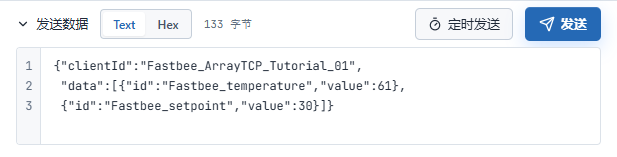
Independent property reporting: 61, 30
Screenshot Key Points
| Field / Control | Description |
|---|---|
| First Message | The complete JSON must not omit the top-level structure or the device identity. Required · Fill in: {"clientId":"FastBee_ArrayTCP_Tutorial_01", "data":[{"id":"FastBee_temperature","value":61}, {"id":"FastBee_setpoint","value":30}]} |
13. Send and Check the Ten Temperature Samples
Location: FMQX Web Send Content; platform device details*→*Running Status Steps: Send the ten samples with temperatures 61 to 70 and setpoint 30 in sequence, then view this guide's device Current Value.
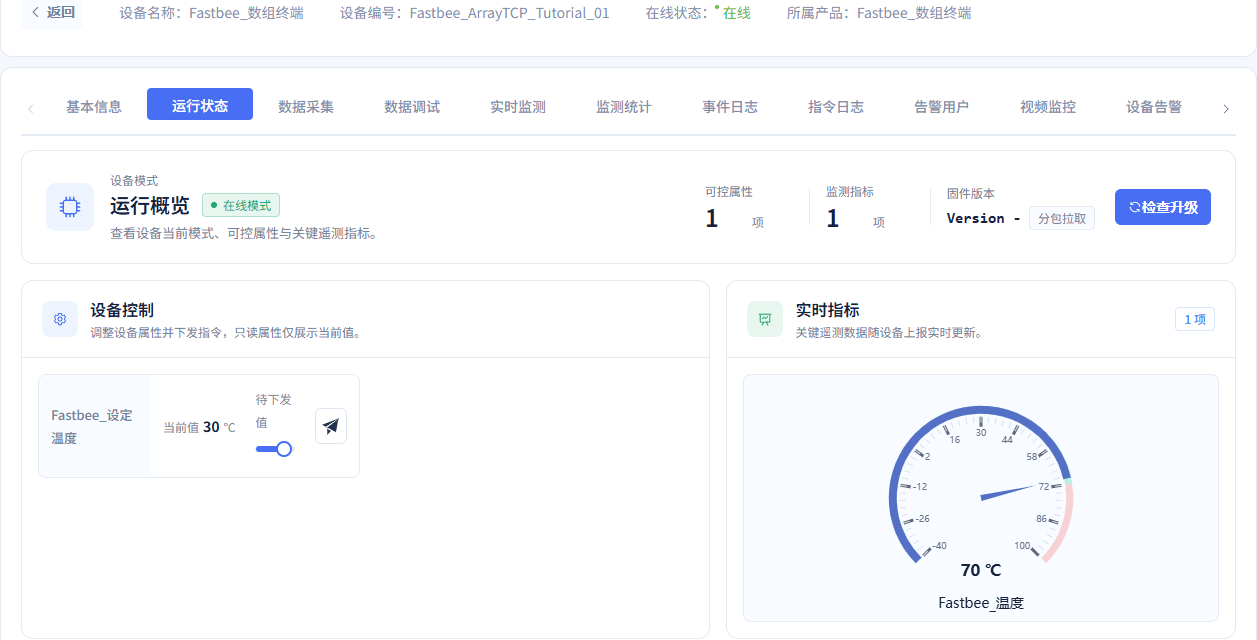
Real-time values after reporting ten temperatures 61 to 70
Screenshot Key Points
| Field / Control | Description |
|---|---|
| Current Value | Comes from the manual independent property state; do not substitute the slider's pending target. Required · Fill in: per the deployment plan · Example: 32; final 34 |
| Temperature Sequence | The setpoint stays at 30; the array element ids are fixed to the corresponding property identifiers, and only the temperature value is changed in sequence. Required · Fill in: 61, 62, 63, 64, 65, 66, 67, 68, 69, 70 |
| Sample Time | Shanghai time; record a new window during re-verification. Required · Fill in: 2026-10-15 23:17:51 ~ 2026-10-15 23:18:13 |
The current value only shows the last state; whether the ten samples are complete must also be checked line by line against the actual history later.
4. Deliver 32 and Report Independently
14. Deliver Target 32
Location: Platform device details*→Running Status→*Setpoint Steps: Adjust the setpoint target to 32, check the overlay, and send once.
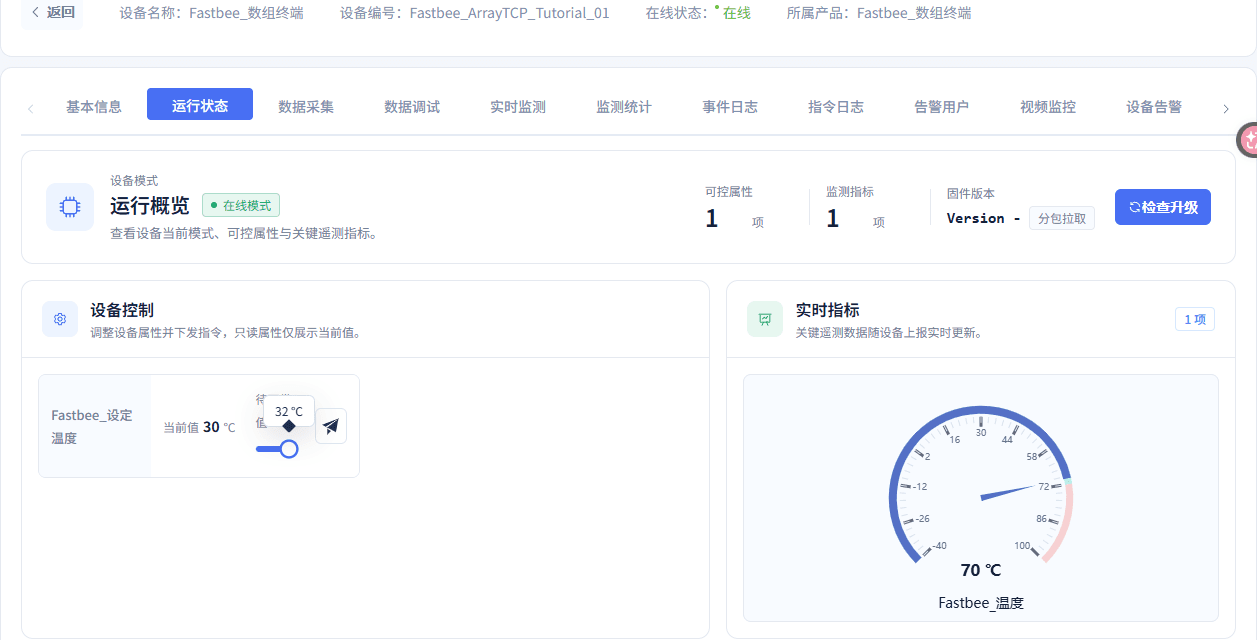
Setpoint 32℃ pending delivery
Screenshot Key Points
| Field / Control | Description |
|---|---|
| Pending Target | Check the overlay; do not treat the current value as the pending target. Required · Fill in: 32 |
15. Check That the 32 Command Was Actually Received
Location: FMQX Web*→This Guide's Session→*Receive Records Steps: Expand the 32 command and check the target value, message id, and message structure.
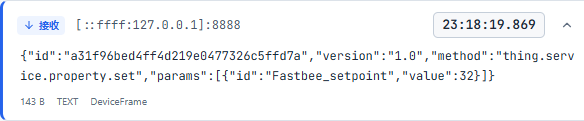
The device received the same-id command for setpoint 32
Screenshot Key Points
| Field / Control | Description |
|---|---|
| Actual Receive Record | Check the complete params array, command id, and target value. Required · Fill in: per the deployment plan · Example: 32/34; 143 bytes |
| This Command id | The subsequent demo reply must correspond to the same id. Required · Fill in: a31f96bed4ff4d219e0477326c5ffd7a |
| Target Value | Follow the message received by the device. Required · Fill in: 32 |
16. Check the 32 Demo Reply
Location: FMQX Web*→This Guide's Session→*Send Records Steps: Expand the demo reply with the same id and check the success code, target value, and execution count.
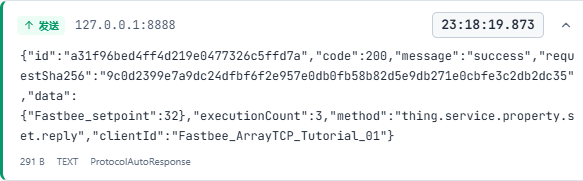
Same-id reply, setpoint 32, 3 cumulative executions
Screenshot Key Points
| Field / Control | Description |
|---|---|
| FMQX Demo Auto-reply | Check the same id, code 200, data, request summary, and actual execution count; each increment is 1, which does not prove physical actuation. Required · Fill in: per the deployment plan · Example: 32: 2→3; 34: 3→4 |
| Execution Count | Use this round's actual baseline; do not treat the cumulative value as the number of executions this time. Required · Fill in: 2 → 3 |
| Command id | Same as the actual receive record. Required · Fill in: a31f96bed4ff4d219e0477326c5ffd7a |
Independent 29/32 property reportingjson
{"clientId":"demo-device",

 "data":[{"id":"temperature","value":29},

{"id":"setpoint","value":32}]}This is a new property message, checked separately from the downlink demo reply. Replaceable customer template names are used here; check against the replacement list in this section before importing or sending.
17. Independently Report 29/32
Location: FMQX Web*→This Guide's Session→*Send Content Steps: Fill in this section's independent property message and send once: temperature 29, setpoint 32.
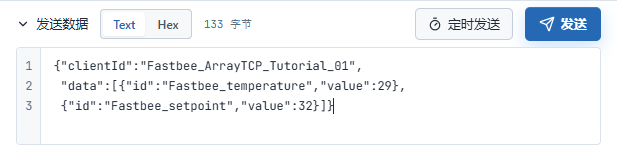
Independent property reporting: 29, 32
Screenshot Key Points
| Field / Control | Description |
|---|---|
| Independent Property Message | Use the JSON array property reporting structure; the array element ids are fixed to the Thing Model identifiers, and value carries this round's actual state. Required · Fill in: {"clientId":"FastBee_ArrayTCP_Tutorial_01", "data":[{"id":"FastBee_temperature","value":29}, {"id":"FastBee_setpoint","value":32}]} |
18. Check the Platform's Current 29/32
Location: Platform device details*→*Running Status Steps: Refresh and check this guide's device temperature and setpoint.
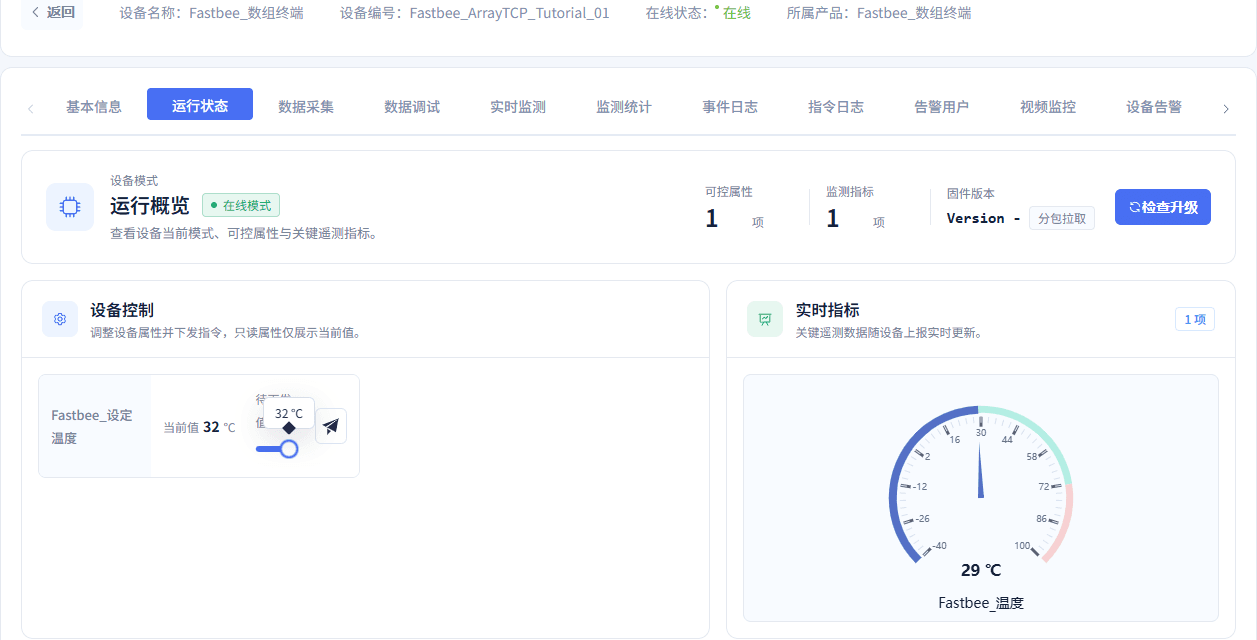
Platform current 32℃ after independent status reporting
Screenshot Key Points
| Field / Control | Description |
|---|---|
| Current Value | Comes from the manual independent property state; do not substitute the slider's pending target. Required · Fill in: per the deployment plan · Example: 32; final 34 |
| Current Status | Not the pending slider target. Required · Fill in: Temperature 29; setpoint 32 |
This round's execution count increased from 2 to 3; the cumulative value does not mean multiple executions this time.
5. Verify 34 After Stop and Recovery
19. Stop This Round's Session
Location: FMQX Web*→*This Guide's Session Title Bar Steps: Stop sending and disconnect this guide's session.

This guide's session disconnected, configuration and data retained
Screenshot Key Points
| Field / Control | Description |
|---|---|
| Stop and Retain Resources | Finishing only disconnects and stops sending; retain business resources and history. Required · Fill in: per the deployment plan · Example: Disconnected; last 29/34 |
20. Restore the Same Device Session
Location: FMQX Web*→*This Guide's Retained Session Steps: Reconnect this guide's session and wait for Connected.

Restore this guide's connection with the original identity
Independent 29/32 property reporting after recoveryjson
{"clientId":"demo-device",

 "data":[{"id":"temperature","value":29},

{"id":"setpoint","value":32}]}The new property message after recovery does not reuse the downlink id. Replaceable customer template names are used here; check against the replacement list in this section before importing or sending.
21. Independently Report 29/32 After Recovery
Location: FMQX Web*→This Guide's Session→*Send Content Steps: Send the post-recovery independent property message: temperature 29, setpoint 32.
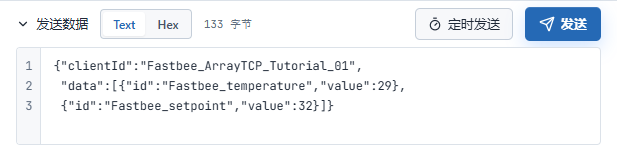
Independent property reporting: 29, 32
Screenshot Key Points
| Field / Control | Description |
|---|---|
| Recovery Property Message | Resend the actual property state; the array element ids remain the corresponding property identifiers. Required · Fill in: {"clientId":"FastBee_ArrayTCP_Tutorial_01", "data":[{"id":"FastBee_temperature","value":29}, {"id":"FastBee_setpoint","value":32}]} |
22. Deliver the Post-recovery Target 34
Location: Platform device details*→Running Status→*Setpoint Steps: Adjust the target to 34, check the overlay, and send once.
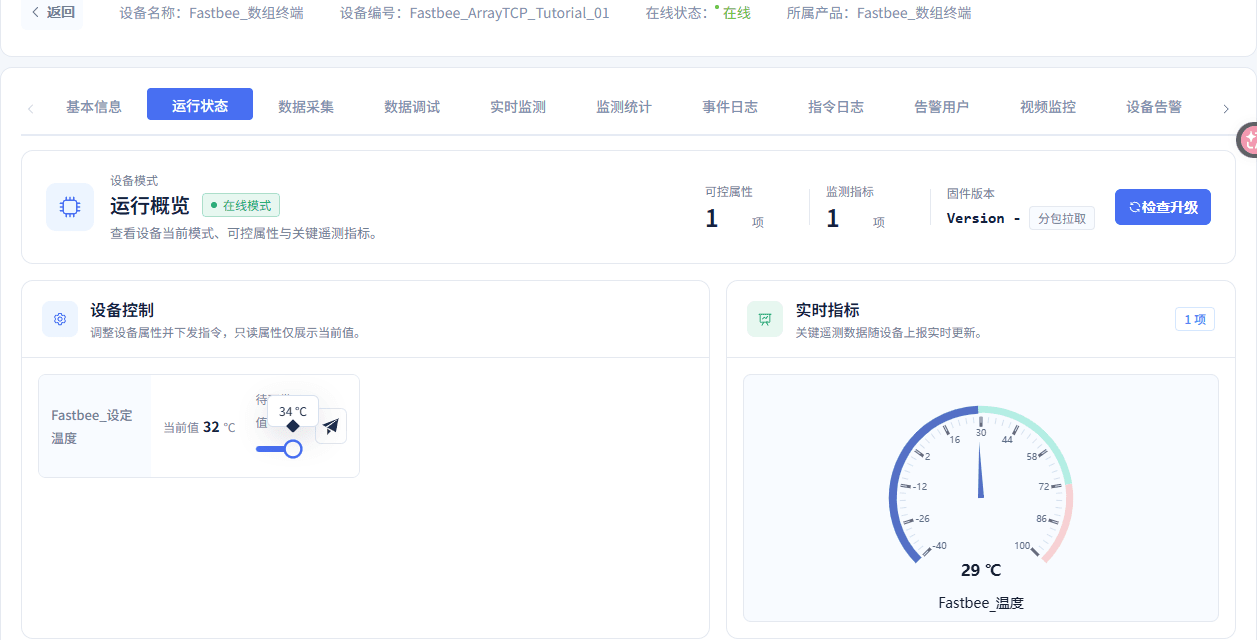
Setpoint 34℃ pending delivery
Screenshot Key Points
| Field / Control | Description |
|---|---|
| Pending Target | Do not write the current value 32 as the pending target. Required · Fill in: 34 |
23. Check That the 34 Command Was Actually Received
Location: FMQX Web*→This Guide's Session→*Receive Records Steps: Expand the 34 command and check the target value and the message id of the same round.
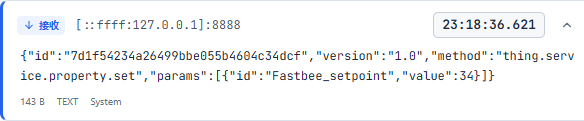
Device actually received setpoint 34
Screenshot Key Points
| Field / Control | Description |
|---|---|
| Actual Receive Record | Check the complete params array, command id, and target value. Required · Fill in: per the deployment plan · Example: 32/34; 143 bytes |
| This Command id | The subsequent demo reply uses the same id. Required · Fill in: 7d1f54234a26499bbe055b4604c34dcf |
24. Check the 34 Demo Reply
Location: FMQX Web*→This Guide's Session→*Send Records Steps: Expand the demo reply with the same id and check the success code, target value, and execution count.
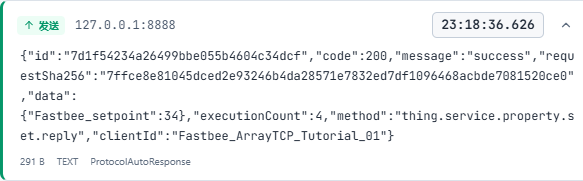
Same-id reply, setpoint 34, 4 cumulative executions
Screenshot Key Points
| Field / Control | Description |
|---|---|
| FMQX Demo Auto-reply | Check the same id, code 200, data, request summary, and actual execution count; each increment is 1, which does not prove physical actuation. Required · Fill in: per the deployment plan · Example: 32: 2→3; 34: 3→4 |
| Execution Count | Use this round's actual baseline; do not treat the cumulative value as the number of executions this time. Required · Fill in: 3 → 4 |
| Command id | Same as the actual receive record. Required · Fill in: 7d1f54234a26499bbe055b4604c34dcf |
Independent 29/34 property reportingjson
{"clientId":"demo-device",

 "data":[{"id":"temperature","value":29},

{"id":"setpoint","value":34}]}Report the final state with a new property message. Replaceable customer template names are used here; check against the replacement list in this section before importing or sending.
25. Independently Report 29/34
Location: FMQX Web*→This Guide's Session→*Send Content Steps: Fill in this section's independent property message and send once: temperature 29, setpoint 34.
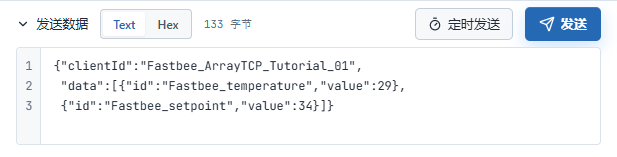
Independent property reporting: 29, 34
Screenshot Key Points
| Field / Control | Description |
|---|---|
| Independent Property Message | Use the JSON array property reporting structure; the array element ids are fixed to the Thing Model identifiers, and value carries this round's actual state. Required · Fill in: {"clientId":"FastBee_ArrayTCP_Tutorial_01", "data":[{"id":"FastBee_temperature","value":29}, {"id":"FastBee_setpoint","value":34}]} |
26. Check the Platform's Current 29/34
Location: Platform device details*→*Running Status Steps: Refresh and check this guide's device temperature and setpoint.
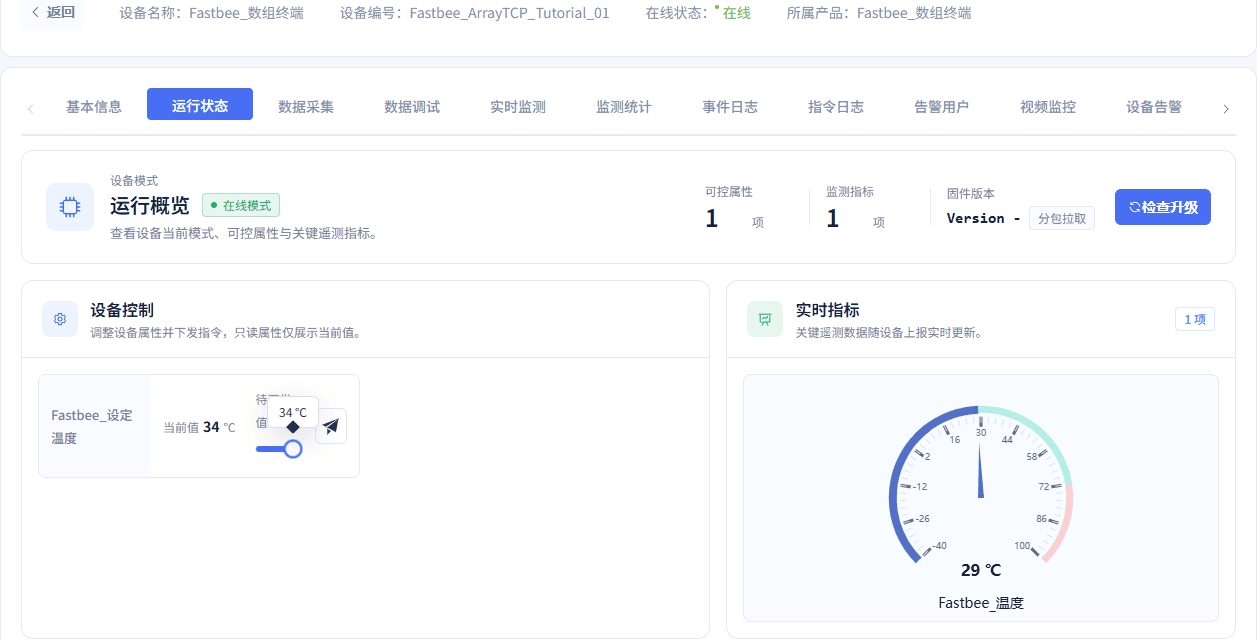
Platform current 34℃ after independent status reporting
Screenshot Key Points
| Field / Control | Description |
|---|---|
| Current Value | Comes from the manual independent property state; do not substitute the slider's pending target. Required · Fill in: per the deployment plan · Example: 32; final 34 |
| Current Status | Not the pending slider target. Required · Fill in: Temperature 29; setpoint 34 |
This round's 34 execution count increased from 3 to 4, only 1 more this time.
6. Query and Refresh Historical Data
Temperature window: 2026-10-15 23:17:51 ~ 2026-10-15 23:18:13. Setpoint window: 2026-10-15 23:18:18 ~ 2026-10-15 23:18:42. All times below are Shanghai time.
27. Set the Complete Temperature Query Time
Location: Data Center*→Historical Data→*Date and Start/End Time Steps: Open the date panel, fill in the complete temperature start/end time, and confirm.
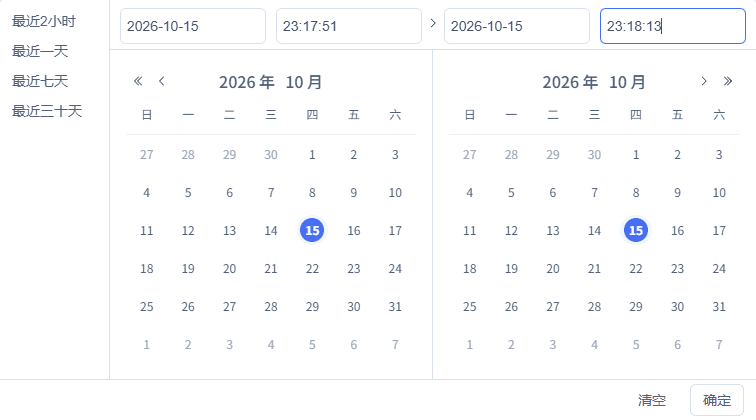
Complete date and start/end time: 2026-10-15 23:17:51 to 2026-10-15 23:18:13
Screenshot Key Points
| Field / Control | Description |
|---|---|
| Date and Start/End Time | Fill in this round's actual complete date and time: temperature 2026-10-15 23:17:51 ~ 2026-10-15 23:18:13; setpoint 2026-10-15 23:18:18 ~ 2026-10-15 23:18:42; other re-verifications must use that round's actual window. Required · Fill in: per the deployment plan · Example: Temperature 2026-10-15 23:17:51 ~ 2026-10-15 23:18:13; setpoint 2026-10-15 23:18:18 ~ 2026-10-15 23:18:42 |
| Complete Start/End Time | Re-verification should use that round's actual send window. Required · Fill in: 2026-10-15 23:17:51 ~ 2026-10-15 23:18:13 |
28. Select This Device and the Temperature Field
Location: Data Center*→Historical Data→*Filter Conditions Steps: Select the temperature field of FastBee_数组终端 and query.

Query after checking this guide's device, property, and time range
Screenshot Key Points
| Field / Control | Description |
|---|---|
| Device and Field | Select the temperature or setpoint of this guide's array terminal. Required · Fill in: FastBee_数组终端; temperature |
29. Refresh the Temperature Query
Location: Data Center*→Historical Data→*Refresh Steps: Click Refresh and wait for loading to complete; if the filter conditions are cleared, restore the same device, field, and complete window and query again.

Refresh and re-query this guide's history
30. Check the Temperature History Results
Location: Data Center*→Historical Data→*Results Table Steps: Read the refreshed temperature history results and check line by line.
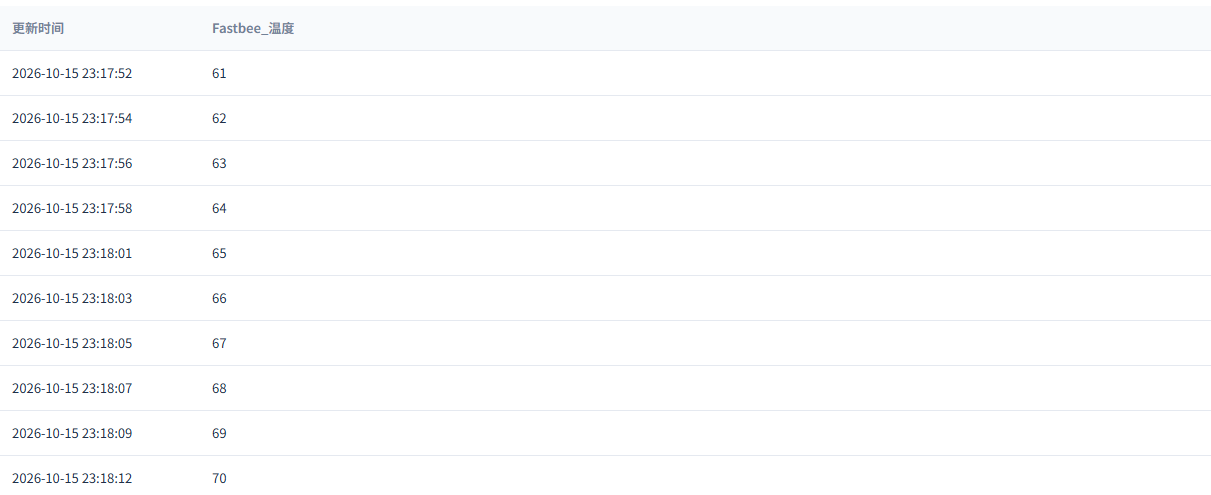
Check this guide's actual history records after refresh
Screenshot Key Points
| Field / Control | Description |
|---|---|
| Device and Field | Select the temperature or setpoint of this guide's array terminal. Required · Fill in: per the deployment plan · Example: FastBee_数组终端; temperature/setpoint |
| Result Order | Follow the actual table within this round's window. Required · Fill in: 61, 62, 63, 64, 65, 66, 67, 68, 69, 70 |
31. Set the Complete Setpoint Query Time
Location: Data Center*→Historical Data→*Date and Start/End Time Steps: Open the date panel, fill in the complete setpoint start/end time, and confirm.
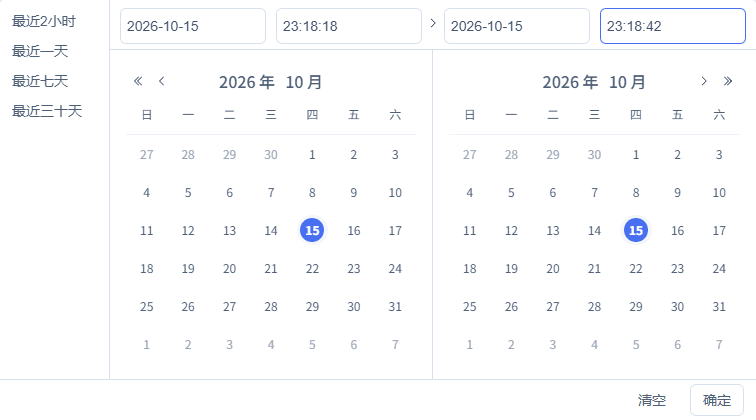
Complete date and start/end time: 2026-10-15 23:18:18 to 2026-10-15 23:18:42
Screenshot Key Points
| Field / Control | Description |
|---|---|
| Date and Start/End Time | Fill in this round's actual complete date and time: temperature 2026-10-15 23:17:51 ~ 2026-10-15 23:18:13; setpoint 2026-10-15 23:18:18 ~ 2026-10-15 23:18:42; other re-verifications must use that round's actual window. Required · Fill in: per the deployment plan · Example: Temperature 2026-10-15 23:17:51 ~ 2026-10-15 23:18:13; setpoint 2026-10-15 23:18:18 ~ 2026-10-15 23:18:42 |
| Complete Start/End Time | Re-verification should use that round's actual send window. Required · Fill in: 2026-10-15 23:18:18 ~ 2026-10-15 23:18:42 |
32. Select This Device and the Setpoint Field
Location: Data Center*→Historical Data→*Filter Conditions Steps: Select the setpoint field of FastBee_数组终端 and query.

Query after checking this guide's device, property, and time range
Screenshot Key Points
| Field / Control | Description |
|---|---|
| Device and Field | Select the temperature or setpoint of this guide's array terminal. Required · Fill in: FastBee_数组终端; setpoint |
33. Refresh the Setpoint Query
Location: Data Center*→Historical Data→*Refresh Steps: Click Refresh and wait for loading to complete; if the filter conditions are cleared, restore the same device, field, and complete window and query again.

Refresh and re-query this guide's history
34. Check the Setpoint History Results
Location: Data Center*→Historical Data→*Results Table Steps: Read the refreshed setpoint history results and check line by line.

Check this guide's actual history records after refresh
Screenshot Key Points
| Field / Control | Description |
|---|---|
| Device and Field | Select the temperature or setpoint of this guide's array terminal. Required · Fill in: per the deployment plan · Example: FastBee_数组终端; temperature/setpoint |
| Result Order | Follow the actual table within this round's window. Required · Fill in: 32, 32, 34 |
The three setpoint history entries are, in order, the state after the first 32 control, the 32 state after recovery, and the state after the 34 control. All three are independent property history; demo replies cannot substitute for them.
7. Finish and Retain This Guide's Resources
35. Finish Send/Receive and Retain Resources
Location: FMQX Web*→*This Guide's Session Steps: Finish sending and disconnect the session.

This guide's session disconnected, configuration and data retained
Screenshot Key Points
| Field / Control | Description |
|---|---|
| Stop and Retain Resources | Finishing only disconnects and stops sending; retain business resources and history. Required · Fill in: per the deployment plan · Example: Disconnected; last 29/34 |
For re-verification, record new send times, keep using the fixed property identifiers as the array element ids, judge each increment against the actual execution-count baseline, and do not reuse old conclusions.
8. Post-send/receive Publish Synchronization Supplementary Check
The following four steps occurred after the above send/receive and are used to check the current publish, automatic page updates, node application, and manual refresh. The device send/receive and history closed loop after the new snapshot still need re-verification.
36. Post-send/receive Supplementary Check: Confirm Publishing the Product
Location: Product Management*→This Guide's Product→*Publish Confirmation Steps: Confirm the current product, then click Confirm Publish.
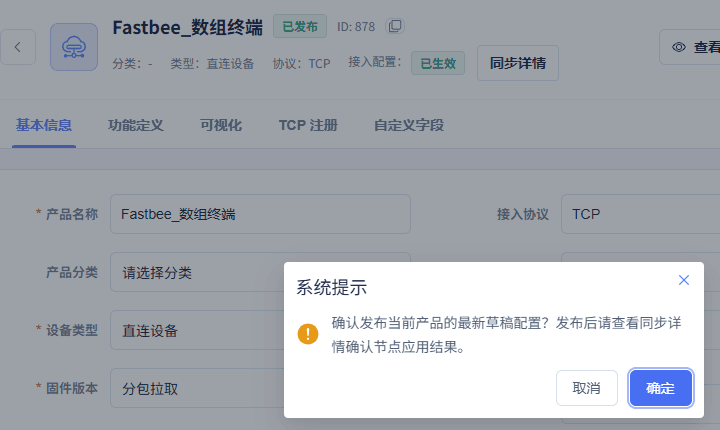
The original screenshot retains this guide's product name, ID, and the complete publish confirmation box.
Screenshot Key Points
| Field / Control | Description |
|---|---|
| Current Product | Operate only this guide's independent product. Required · Fill in: FastBee_数组终端; 878 |
37. Observe the Automatic Update of the Sync Summary
Location: Product Details*→Product Summary→*Access Configuration Sync Steps: Stay on the current page and wait for the sync summary to update.

This guide's product access configuration has taken effect
Screenshot Key Points
| Field / Control | Description |
|---|---|
| Access Configuration Sync | The current publish receipt after this round's send/receive; it cannot serve as the snapshot source for the earlier ten samples. Required · Fill in: per the deployment plan · Example: APPLIED; success 1, failure 0; snapshot 1987 |
38. Expand the Current Node Application Receipt
Location: Product Details*→*Sync Details Steps: Open Sync Details and check this guide's product identity, node results, and effective time.
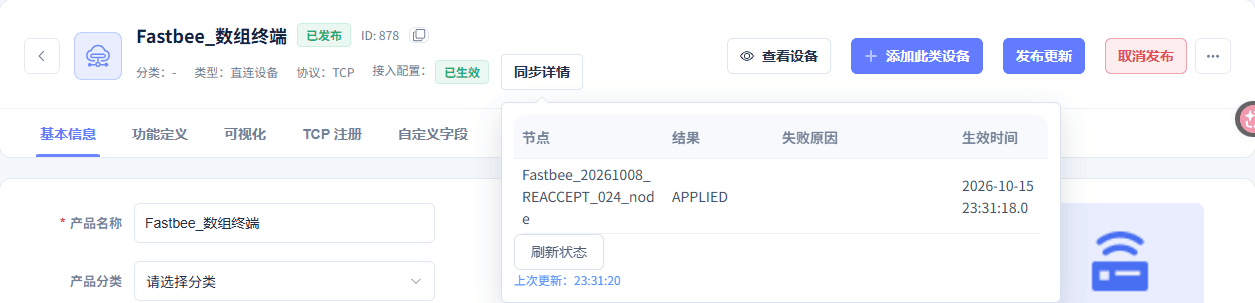
Application receipt for this guide's product and access node
Screenshot Key Points
| Field / Control | Description |
|---|---|
| Access Configuration Sync | The current publish receipt after this round's send/receive; it cannot serve as the snapshot source for the earlier ten samples. Required · Fill in: per the deployment plan · Example: APPLIED; success 1, failure 0; snapshot 1987 |
| Current Snapshot | Only proves this publish synchronization; do not attribute the earlier send/receive to this snapshot. Required · Fill in: 1987 |
39. Manually Refresh the Current Sync Status
Location: Product Details*→Sync Details→*Refresh Status Steps: Click Refresh Status and wait for this check to complete.
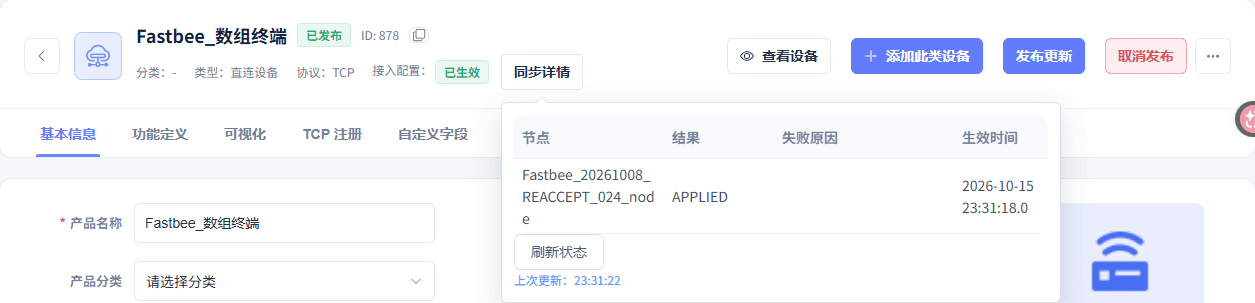
Manually refresh the current node application receipt
Field and Parameter Reference
Device Access Wizard
| Field / Control | Fill-in Instructions |
|---|---|
| Access Source | Create a new independent product in this guide; re-verification directly reuses the retained resource. Required · Fill in: New ProductExisting Product: use an existing model; use an existing model. New Product: adopted in this guide; adopted in this guide. Copy Product: copy an existing configuration; copy an existing configuration. Use Template: use an existing template; use an existing template. |
| Product/Device Name | Use a short business name to locate this guide's product and device. Required · Fill in: FastBee_数组终端 |
| Wizard JSON Object Sample | First generate two fields from the object, then switch to JSON array/TCP in the product details. Required · Fill in: {"FastBee_temperature":20,"FastBee_setpoint":30} |
| Fields, Types, Units, and Paths | Two integer properties correspond one to one, ℃. Required · Fill in: FastBee_temperature, FastBee_setpoint; integer; ℃ |
| Device Identifier | Matches the clientId of every report; the FMQX session id cannot be used as a substitute. Required · Fill in: FastBee_ArrayTCP_Tutorial_01 |
| Initial Access Overview | 1 device, 2 fields; the wizard starts with JSON/MQTT, and the formal format is changed afterward. Required · Fill in: 1 device, 2 fields |
Protocol and Publish Effectiveness
| Field / Control | Fill-in Instructions |
|---|---|
| Data Format | This guide's formal JSON array. Other formats belong to separate scenarios. Required · Fill in: JSON ArrayPublish after modification. |
| Transport | Select TCP; the device actively connects to the FMQ listen entry and does not use MQTT topics. Required · Fill in: TCPPublish after modification. MQTT: an MQTT identity and topic scenario, not chosen in this guide; an MQTT identity and topic scenario, not chosen in this guide. TCP: this guide's device actively establishes a streaming connection; this guide's device actively establishes a streaming connection. UDP: a datagram scenario, not chosen in this guide; a datagram scenario, not chosen in this guide. |
| Network Type | Keep this guide's WIFI; do not treat it as the TCP entry configuration. Required · Fill in: WIFIPublish after modification. |
| Publish/Confirm | Unpublish first before modifying a published product; publish and confirm after saving. Publish after modification. |
| Access Configuration Sync | The current publish receipt after this round's send/receive; it cannot serve as the snapshot source for the earlier ten samples. Required · Fill in: APPLIED; success 1, failure 0; snapshot 1987Publish after modification. |
| Refresh Status | Re-read the current sync summary and node receipts, updating the check time. Publish after modification. |
Function Definition
| Field / Control | Fill-in Instructions |
|---|---|
| Model Translation | Complete the English names, then Modify to save. Required · Fill in: Temperature/SetpointPublish after modification. |
| Model Identifier | The ids of the data array elements must match the identifiers verbatim. Required · Fill in: FastBee_temperature/FastBee_setpointPublish after modification. |
| Model Category | Both are properties. Required · Fill in: PropertyPublish after modification. Property: this guide adopts a reading and a writable setpoint; this guide adopts a reading and a writable setpoint. Function: this guide does not use a standalone function model; this guide does not use a standalone function model. Event: this guide does not use an event model; this guide does not use an event model. |
| Read-only Data | Temperature checked, setpoint unchecked. Required · Fill in: Temperature read-only; setpoint writablePublish after modification. Checked: only displays readings; only displays readings. Unchecked: allows control per permission; allows control per permission. |
| History Storage | Enabled for both properties. Required · Fill in: CheckedPublish after modification. Checked: saves subsequent reports; saves subsequent reports. Unchecked: subsequent history cannot be checked per this guide; subsequent history cannot be checked per this guide. |
| Chart Display/Real-time Monitoring | Temperature on, setpoint off. Required · Fill in: Temperature on, setpoint offPublish after modification. Checked: adopted for temperature; adopted for temperature. Unchecked: adopted for setpoint; adopted for setpoint. |
| Share Permission | This guide stays within its tenant scope. Required · Fill in: UncheckedPublish after modification. Checked: decided by tenant policy; decided by tenant policy. Unchecked: adopted in this guide; adopted in this guide. |
| Integer Range, Unit, Step | Temperature -40~100℃, setpoint 16~35℃, step 1, formula left empty. Required · Fill in: Integer; ℃; step 1Publish after modification. |
| Modify/Cancel | Modify to save; Cancel does not submit. Publish after modification. |
FMQX Web Connection
| Field / Control | Fill-in Instructions |
|---|---|
| Configuration File/Import Configuration | Import this guide's UTF-8 configuration without credentials. Reconnect after modification. |
| Host / IP | FMQ server listen address; 127.0.0.1 is only for the same machine. Required · Fill in: 127.0.0.1Reconnect after modification. |
| Port | FMQ's TCP listen port, not the device's local port. Required · Fill in: 8888Reconnect after modification. |
| Receive Mode | This guide uses byte stream; by-line mode is not enabled. Required · Fill in: tcpLineMode=falseReconnect after modification. Byte stream: verified in this guide; verified in this guide. By line: not adopted in this guide, do not switch arbitrarily; not adopted in this guide, do not switch arbitrarily. |
| Keep Alive | System default; TCP keep-alive does not equal the device business heartbeat. Required · Fill in: System defaultReconnect after modification. System default: adopted in this guide; adopted in this guide. Custom: verified separately per deployment requirements; verified separately per deployment requirements. |
| Connection Timeout | Upper limit of connection waiting, in milliseconds. Required · Fill in: 5000 msReconnect after modification. |
| Auto Reconnect/Reconnect Interval | Auto reconnect is disabled in this guide, the 3000 ms interval is retained, and recovery is verified manually. Required · Fill in: Off; 3000 msReconnect after modification. Off: manual recovery in this guide; manual recovery in this guide. On: automatic recovery needs separate acceptance; automatic recovery needs separate acceptance. |
| Test Connection/Save Configuration | Saved during the first configuration; this round only expanded the parameters read-only, without re-saving or testing the connection. Reconnect after modification. |
| Connect/Disconnect | Check this device and endpoint first, then connect or stop. Reconnect after modification. |
Device Reporting and Demo Reply
| Field / Control | Fill-in Instructions |
|---|---|
| clientId Identity | Each input envelope of this guide carries this device number. Required · Fill in: FastBee_ArrayTCP_Tutorial_01 |
| data Array | The element ids are fixed model identifiers and value is an integer; do not change an id to a sample serial number. Required · Fill in: data=[{id,value},{id,value}] |
| Text/Send | Complete UTF-8 JSON; after preparation, send each message once and check one by one. |
| Actual Receive Record | Check the complete params array, command id, and target value. Required · Fill in: 32/34; 143 bytes |
| FMQX Demo Auto-reply | Check the same id, code 200, data, request summary, and actual execution count; each increment is 1, which does not prove physical actuation. Required · Fill in: 32: 2→3; 34: 3→4 |
Device Running Status
| Field / Control | Fill-in Instructions |
|---|---|
| Setpoint Slider/Send | 32 first within the model's allowed range, 34 after recovery. |
| Current Value | Comes from the manual independent property state; do not substitute the slider's pending target. Required · Fill in: 32; final 34 |
Historical Data
| Field / Control | Fill-in Instructions |
|---|---|
| Device and Field | Select the temperature or setpoint of this guide's array terminal. Required · Fill in: FastBee_数组终端; temperature/setpoint |
| Date and Start/End Time | Fill in this round's actual complete date and time: temperature 2026-10-15 23:17:51 ~ 2026-10-15 23:18:13; setpoint 2026-10-15 23:18:18 ~ 2026-10-15 23:18:42; other re-verifications must use that round's actual window. Required · Fill in: Temperature 2026-10-15 23:17:51 ~ 2026-10-15 23:18:13; setpoint 2026-10-15 23:18:18 ~ 2026-10-15 23:18:42 |
| Advanced Filter/Query/Refresh | After refreshing, reselect the same conditions and wait for loading to finish. |
Stop and Recovery
| Field / Control | Fill-in Instructions |
|---|---|
| Stop and Retain Resources | Finishing only disconnects and stops sending; retain business resources and history. Required · Fill in: Disconnected; last 29/34 |
Where to Check First When Problems Occur
| Symptom | Possible Cause | Where to Check First | How to Recover |
|---|---|---|---|
| Connection failure | Device identity, endpoint, or authorization parameters do not match | First check this guide's session name, address, port, and platform device identity | Fix the authorization configuration and reconnect; no connection-fault injection was performed this round |
| Platform submitted but the device did not actually receive | Downlink route or device connection does not match | Check the same TCP connection, endpoint, and device identity | Stop repeated control, locate the route first, then re-verify with a new command |
| Reply succeeded but the current value did not update | The demo reply and the property state are two different messages | Check the independent property reporting and this device's current value | Report the actual state independently first; do not treat a pending target as the current value |
| History entry count mismatch | The device, field, or query time does not correspond to this round | Expand the complete date panel, restore the same device and field, then refresh | Check line by line against the actual window; do not pad samples with old data |
| Sync status needs reconfirmation | The current viewing time is earlier than the new receipt | Check the current product and snapshot, then click Refresh Status | Retry later if reading fails; the browser did not inject this fault this round, and only component tests cover the recovery path |